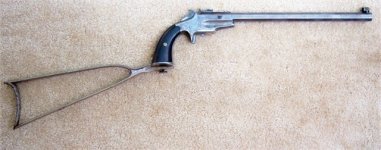
The attached image shows a "pocket rifle" made in the 1870s. It is a single shot with a 12 inch barrel and removable stock. Is this a simple "antique", that can be bought and owned with no FFL or other legal processes? Or do special legal requirements apply to something like this? I am asking about federal law; my state is relatively open for such things.

You are using an out of date browser. It may not display this or other websites correctly.
You should upgrade or use an alternative browser.
You should upgrade or use an alternative browser.
Special aspects for an antique
- Thread starter cjwils
- Start date
carguychris
New member
There are no special requirements under federal law. All firearms made before 1/1/1899 are legal antiques, period.
BUT...
The burden of proof is on the parties transferring such a firearm to demonstrate that the gun was, in fact, made before 1899. Beware of fakes.
EDIT: In the case of this particular gun, it appears the barrel is less that 16" long, so be aware of the federal NFA guidelines if it fires conventional metallic cartridge ammunition.
http://www.atf.gov/firearms/guides/...irearms-verification-nfa-antique-firearm.html
BUT...
The burden of proof is on the parties transferring such a firearm to demonstrate that the gun was, in fact, made before 1899. Beware of fakes.
EDIT: In the case of this particular gun, it appears the barrel is less that 16" long, so be aware of the federal NFA guidelines if it fires conventional metallic cartridge ammunition.
http://www.atf.gov/firearms/guides/...irearms-verification-nfa-antique-firearm.html
Last edited:
Rifleman1776
New member
Very true. I had a friend convicted (he was sentenced Tuesday) for having a short rifle in violation of NFA. This came even though, in court, it was proven the gun was made before the NFA went into effect and it was supposedly therefore exempt. It was his military survival rifle, he was special ops and it was given to him on his retirement after 34 years service.
Don't say "they can't do that". They did do that.
Be careful out there.
Don't say "they can't do that". They did do that.
Be careful out there.
carguychris
New member
+1. I would recommend reposting this thread on the "NFA Guns & Gear" subforum and asking how this gun's potential NFA status affects its transferability.This came even though, in court, it was proven the gun was made before the NFA went into effect and it was supposedly therefore exempt... Don't say "they can't do that". They did do that.
I will admit that I am largely ignorant regarding NFA regulations, but my basic understanding is that the gun could be exempt IF it is all-original. The problem is the big fat "IF".
Reread what I wrote earlier about burden of proof. Let it sink in. Mull it over for a little while. Do you know the gun is pre-1899 and all-original? How? What do you really know about the gun's provenance, and can you prove it beyond a reasonable doubt?
This would not be nearly as thorny of an issue without the potential NFA question. When it comes to NFA items, the Feds don't play around.

Uncle Buck
New member
The gun in the picture is only legal in Missouri. Please send it to me and I will ensure it gets a proper home. 
With so many laws and restrictions on guns, and opinions from the BATFE, it is a wonder anyone can own an antique gun.
Do your homework and make sure you are legal. I would hate to see such a beautiful thing end up in some scrap pile to be melted down.
With so many laws and restrictions on guns, and opinions from the BATFE, it is a wonder anyone can own an antique gun.
Do your homework and make sure you are legal. I would hate to see such a beautiful thing end up in some scrap pile to be melted down.
carguychris said:There are no special requirements under federal law. All firearms made before 1/1/1899 are legal antiques, period.
NOT TRUE! While it may be true for firearms regulated under the Gun Control Act, it is not true for those firearms regulated under the National Firearms Act. There are two different legal definitions of an antique firearm in the two acts. The primary difference is in how the firearm using fixed cartridges affects the definition.
Also, the firearm the OP has may no longer be regulated by the NFA. Several models of the Stevens Pocket Rifle have been removed from the NFA and also removed from the GCA as antiques. See Section IIIA of the BATF Firearms Curios or Relics List.
SECTION IIIA: Weapons Removed From The NFA As Collector's
Items And Removed From the GCA As Antiques.
The following firearms were removed from the NFA as collector's items and classified as curios or relics under 18 U.S.C.
Chapter 44. However, because they are antiques as defined in Chapter 44, they should not have been classified as curios
or relics. Because they are no longer NFA weapons and are antiques under Chapter 44, they are not subject to GCA
provisions.
Any pistol or revolver, mfd. in or before 1898, originally designed to accept a shoulder stock, and accompanied
by an original shoulder stock.
Stevens, Old model Pocket Rifle, .22 short or long rimfire.
Stevens, Reliable Pocket Rifle, first issue, cal. .22 short, long or long rifle.
Stevens, New Model Pocket Rifle, first issue, in cal. .32 short or long rimfire.
Stevens, New Model Pocket Rifle, 2nd issue, in cals. .25 Stevens or .32 long rimfire.
Stevens, New Model Pocket Rifle No. 40, in cal. .25 Stevens or .32 long rimfire.
Stevens, New Model Pocket shotgun, in cal. .44-50 Everlasting.
Stevens, Vernier, New Model Pocket Rifle, cal. .22 short, .22 long rifle, .22 WRF, .32 long rimfire.
Stevens, Vernier, New Model Pocket Rifle, No. 40 1/2, in cal. .25 Stevens or .32 long rimfire.
To further [muddy|clarify] the waters, it's not terribly difficult to petition the ATF to declare a firearm a curio or relic or to have it removed from the NFA. In particular, if you look through the C&R book, you'll see a number of examples of specific Winchester rifles, identified with serial numbers, that were manufactured with short barrels. Normally, they'd be an SBR, regulated by the NFA. All it takes is a request, accompanied by a letter from, say, the curator of a museum attesting to the value of the item as a curio or relic and the ATF can exempt it from the NFA and put it on the C&R list. That's not to say they will, but it's not too tough to ask.
But, as EOD Guy posted, the gun in the OP probably fits the exemption already allowed.
But, as EOD Guy posted, the gun in the OP probably fits the exemption already allowed.