Sniper Rifle vs Hunting Rifle

Status
Not open for further replies.
To be a sniper, you've got to back it up. It isn't the rifle, it's the man behind it.

Simo Hayhai has arguably the most kills as a sniper. 505 confirmed kills during the Winter War in Finland. He used a Model 28/30, a variant of the Mosin-Nagant. With iron sights.

On the other hand, Carlos Hathcock reportedly used a Model 70 Winchester, and a scope-mounted Browning M2.

It's not the rifle, it's the man behind it.
 
A sniper is a person not a thing. Any rifle carried by a sniper is a snipers rifle but it's not a "sniper rifle". It is still just a rifle no matter who carries it.
 
Hard for me to get worked up about it. Some labelling is purely marketing, so I just ignore it. To me, generally, rifles are either mostly for hunting, or mostly for targets. Some few are sorta crossover.

Seems like using "sniper", "tactical" or "police" is somewhere in the neighborhood of 99 and 44/100 percent marketing--or being influenced by it to the point of worrying about it. :)
 
In the current climate, the actual meanings don't matter. I was very much around when JFK was killed and the Carcano was described as a deadly, long range military sniiper rifle. There were several proposals to ban "military style" rifles, copies of the evil Nazi Mauser; that meant, of course, all bolt action rifles.

If the antis succeed in banning "assault rifles", they are not going to quit. Some are so full of hatred for all guns and gun owners that they won't stop short of a Holocaust for all "gun freaks". Others love the fame and the money that espousing gun control brings them. Either way, they won't quit.

Jim
 
In my country informal requirement for hunting rifle is to make a group of maximum 4-5 cm at some distance. Assumed that target is most common European big game (a roe buck), and delivering a lethal shoulder shot.
The size of group will also determine useful range of a rifle in hunting for individual hunter and his (scoped) rifle.

Two inch group is not much of a accuracy requirement, if we are speaking of at least 100 meters ranges. As per our law - maximum range in big game hunting is 150 meters, in order to prevent wounding of animal

Reading it other way - extreme accuracy is not expected from a hunting high power rifle.

On the other hand, long range target shooting equipment will need to have sub MOA accuracy.
The competition rules say that you will fire 10 rounds in 10 minutes at target at given ranges (usually 300 and 600 meters). So, the competitors will surely want their barrels not to heat up too much, as thermal dilatation of barrel may change ballistics of rifle with bad effect on target. That's another characteristic required. However, we are still talking about sport.

In professional sniper rifle, I guess - one shot - one kill rule applies, so barrel heating is not an issue in repetitive shots, but sub MOA accuracy should apply, especially for long range shooting.

In conclusion, I would say - sub MOA accuracy for longe range target shooting and sniping. Plus MOA accuracy for hunting.

Having said that, this will define another difference: high performance rifles will cost higher with their expensive barrels, then medium class rifles for hunting with hammered barrels of cheaper production.
 
I think Thump_rrr hit it on the head. A big differentiator is weight.

When you're hunting, you're going to be carrying the rifle much more than shooting it, and you may be climbing with it, backpacking with it, and/or covering a lot of ground with it. The weight of the rifle is critical, and many hunters use bolt actions that are relatively lightweight...barrels, polymer stocks, etc.

Long-Range Precision Rifles tend to have barrels that are designed to minimize fluctuation and maximize consistency, they're thicker and heavier, they may have bipods and more complex optics, and there may be many other design aspects that tend to add weight to the weapon.

Any rifle can possibly serve either purpose - true. But for hunting deer and elk, especially at high altitudes in the Colorado Rockies where I hunted, a lighter rifle meant I could go further with it.

JMHO. YMMV.
 
The way I look at it:

If you are a sniper (SWAT, military, ect,) then you have a sniper rifle
If you are a hunter then you have a hunting rifle
If you a sniper and you take you rifle you use for sniping hunting, it's a hunting rifle.

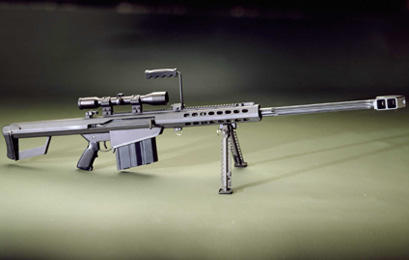
All that being said, when someone says sniper rifle I think of something like this,
Barrett82A1.jpg
 
Two inch group is not much of a accuracy requirement,On the other hand, long range target shooting equipment will need to have sub MOA accuracy.............

In professional sniper rifle, I guess - one shot - one kill rule applies,
In conclusion, I would say - sub MOA accuracy for longe range target shooting and sniping. Plus MOA accuracy for hunting.

Not sure I agree with most of what you posted. Carlos Hathcock had a Model 70 target rifle that was in fact a 2 MOA rifle. He did quite well.

I really doubt Simo Häyhä's iron sighted Mosin was near that, he did quite will.

Military snipers are taught to aim center mass. The average width shoulder to shoulder of a soldier is 19 inches (hense the measurements chosen for the E Shillotte target 19 X 40).

A 2 MOA right is good on that target to 950 yards. The vital area of, lets say an antelope is about 8 inches. That same 2 MOA is only good for 400 yards.

To refine it further I use to with Alaska Natives to hunt seals in the Bering sea. Normally you only get a head shot on those little buggers bobbing around in the water, that's about 3 inches. The 2 MOA rifle is good for 100 yards. Try to get that close and the suckers dive.

LE Snipers or to be PC Counter snipers are taught head shots, (different ball game then military snipers). The round needs to be kept inside 4 inches to be effective. In theory thats 150 yards, BUT, you probably wont get that, you'll get a partical head behind a hostage, 1-2 inches if you're lucky. That brings you back to 100 yards or under.

I don't put much stock in MOA size, because as I posted several times, you see people posting sub MOA groups with their rifle all the time, but you see very few "Cleaned 1000 yard targets". The X-10 ring on the NRA 1000 yard target is 20 inches or 2 MOA.

So what does this mean?.......................ITS THE SHOOTER NOT THE RIFLE.

And its not only the ability to judge wind and other weather conditions. Best example here is the CMP GSM Vintage Military Matches that are shot at 100 or 200 yards. Wind 'n such is not a big handy cap here.

Just about any diecent surplus military rifle is good for 3.5 MOA, and that's the size of the targets used in the GSM matches, X-10 ring being 3.5 MOA. Again, very few cleaned targets.

 
I have never seen a model 70 heavy barrel, standard barrel, light barrel, light weight, or anything else that was 2MOA. They are much better than that.
 
As a former Australian army sniper I get ticked off when people use the term sniper rifle because a sniper is someone who is highly trained and gone though a difficult course to earn the term sniper...

A sniper can be anyone sniping at you. You don't have to have grand training to be a sniper. There are trained people who have the title of sniper, but anyone can snipe and be considered a sniper. It is a regular occurrence for NATO forces to report a "sniper" anytime being fired on from a position of concealment. So even an untrained Taliban fighter with an AK47 can snipe.

Remember, the origin of the word pertains to being able to "hunt" snipes.

Sniper rifle or hunter rifle - marketing. Funny how lots of "sniper" rifles used by the military have been nothing more than hunting rifles applied in warfare.
 
I have never seen a model 70 heavy barrel, standard barrel, light barrel, light weight, or anything else that was 2MOA. They are much better than that.

As much as I agree with that statement I didn't want my bias for the Model 70 Winchester to cloud the issue.
 
I am starting to think that the cosmetics and/or the caliber are what defines it, as much as I hate to admit that cosmetics determines a type of rifle (AWB). Like the Barrett .50, purely for sniping. And to whoever said that a hunting rifle will be carried all over mountains and sniper rifle not, a sniper walks super long distances over difficult terrain often to set up their shot. They don't just hop out of the Humvee and take pot shots at a HVT.

Also, I don't know if I agree with Gary above, because we certainly aren't using a varmint rifle to kill moose, and I have heard many a story about some old, beat up 30-06 taking one down, certainly not a target rifle.
 
Kraig's comments on accuracy in rifles snipers use is credible. More detailed history of the best ones ever used follows.

The United States Marine Corps purchased 373 Model 70 National Match rifles (ones with a clip guide in the receiver bridge) in May, 1942. Although the Marine Corps officially used only the M1 Garand and the 1903 Springfield as sniper rifles during the Second World War, "many Winchester Model 70s showed up at training camps and in actual field use during the Pacific campaign. These rifles had 24-inch sporter barrels chambered for .30-06 Springfield. These rifles had serial numbers in the 41000 to 50000 range and were fitted with leaf sights and checkered stocks with steel butt plates, one-inch sling swivels, and leather slings. It has been reported that some of these rifles were equipped with 8X Unertl telescopic sights for limited unofficial use as sniper weapons on Guadalcanal and during the Korean War.

Many of the surviving rifles, after reconditioning with heavier Douglas barrels and new stocks between 1956 and 1963 at the Marine Corps match rebuild shop in Albany, Georgia, were fitted with 8X Unertl sights from M1903A1 sniper rifles. The reconditioned rifles were used in competitive shooting matches; and the United States Army purchased approximately 200 new Model 70 National Match Rifles with medium heavy barrels for match use between 1954 and 1957. Many of the reconditioned Marine Corps match rifles were used by Marine Corps snipers during the early years of the Vietnam war with M72 match ammunition loaded with 173-grain boat-tailed bullets. A smaller number of the Army's Model 70 rifles also saw combat use by Army snipers; and some were equipped with silencers for covert operations in Southeast Asia. These Model 70 rifles never achieved the status of a standard military weapon; but were used until replaced by the Remington Model 700 series bolt-action rifles which became the basis for the M40 series sniper rifle.

I believe Hathcock's Win. 70 was one of those highlighted above. The ammo was standard M72 match ammo with an accuracy spec at 600 yards of 3.5" mean radius; about 10 inches (1.67 MOA) extreme spread. Some lots of M72 would shoot close to 1 MOA extreme spread at 600 yards in arsenal test barrels. Winchester factory barrels would shoot that ammo almost as accurate. I've heard mixed reports on the Douglas barreled ones accuracy.

I've seen some accuracy specs for sniper rifles and none of them are smaller than 1 MOA at 1000 yards. Without handloading ammo matched dimensionally for a given barrel, I doubt anyone could produce accuracy better than 1.25 MOA at 1000 yards. No sniper I know of uses ammo custom loaded for his rifle; it's all mass produced to be easily interchangeable across several in an organization.
 
Last edited:
That "guy" is an idiot.

Sniper vs Hunting is a meaningless debate for reasons listed...

Also, I believe that the guy whom compared it to the "assault rifle" smear campaign is spot on.

Sniper
A sniper is a highly trained marksman who operates alone, in a pair, or with a team to maintain close visual contact with the enemy and engage targets from concealed positions or distances exceeding the detection capabilities of enemy personnel. Wikipedia
Feedback

Looks like if you replace "enemy" with "deer", this is the definition of deer hunter.
 
Also, I don't know if I agree with Gary above, because we certainly aren't using a varmint rifle to kill moose, and I have heard many a story about some old, beat up 30-06 taking one down, certainly not a target rifle.

LOL, you can call your rifle a "George." It doesn't care what you call it or how you classify it. You can certainly take a moose with a varmint rifle. I have a .45-70 varmint rifle and use it for a varmint called Sus scrofa. Folks have used the 1895 .45-70 for moose for well over 100 years.


The military and police have sniper rifles.
Just curious, when the police snipers have to shoot animals, do the sniper rifles they use become hunting rifles?

Sniper bovicide
http://missoulian.com/news/state-an...cle_f4d4c374-ebed-11e1-b754-001a4bcf887a.html
 
I'm sorry, but I can't consider the M-1107 a sniper rifle at the exclusion of others.

The rifle was designed for the anti-material role. It had and continues to serve in the long range sniping role, but all the guys in our Sniper Section preferred the M-110 or M-24, with the .300 Winchester Magnum and .338 Lapua replacing the .50 BMG in the long range role.

I've said it before, and it bears repeating, if the gun grabbers are targeting semi-automatic rifles today, so-called assualt weapons, then tomorrow they will be after bolt action rifles, the so-called sniper rifles.

A sniper doesn't have to have a super special scoped rifle to be a sniper, just like the guy with a scope on the top of his AR-15 isn't automatically a sniper.
 
Status
Not open for further replies.
Back
Top