Number of shots/groups for feeling certain of your rifle's accuracy?

With a rifle which is new to me, I'll first try a five-shot group with my standard handload (for '06, .243 or .223). If it's not very good, I'll try a repeat before "tweaking".

Generally, I can meddle around a bit with the rifle and usually get it to one MOA if not better. Anything inside one MOA for five shots is plenty good for my satisfaction.

Anyhow, once I'm satisfied with the rifle, sight-in and load-testing is mostly with three-shot groups.
 
it depends on what you want in the rifle. I am a hunter not benchrest competitor. I shoot 3 shoot groups with allowing the barrel to cool between shots for load development and zero. I will then check how the rifle behaves by shooting 3 shot groups rather rapidly.

My true test of consistently is to check the rifle occasionally and at varied ranges after I have zeroed it. Ultimately, the true test is 8" diameter paper plates at 100-200-300 yards fired from varied shooting positions.
 
I regularly participate in military bolt matches which are shot on the SR-21 at 100 yards. The first target posted is the full size SR-21 for sighters, then overlayed five times with the SR-21C for each leg of the match. When the match is complete you have a composite of 50 rounds on the original SR-21. Wanna know where your real center of group lies? Look at the composite. A good shooter will have a golf ball or baseball size hole in the composite target.
 
Let's use a little logic here.There are four uses for the rifle (I think).
1- Hunting or plinking
2- Target shooting
3- War
4- Decorative over the mantle
How many shots you may need to determine the required accuracy depends on how many shots may be required to fire during the activity in which you may be engaged and over what length of time. For #1 three shots are sufficient. For #4 none are required. For #s 2&3 twenty or more may be required, fired in a short period of time. You be the judge what activity in which you are going to participate.
 
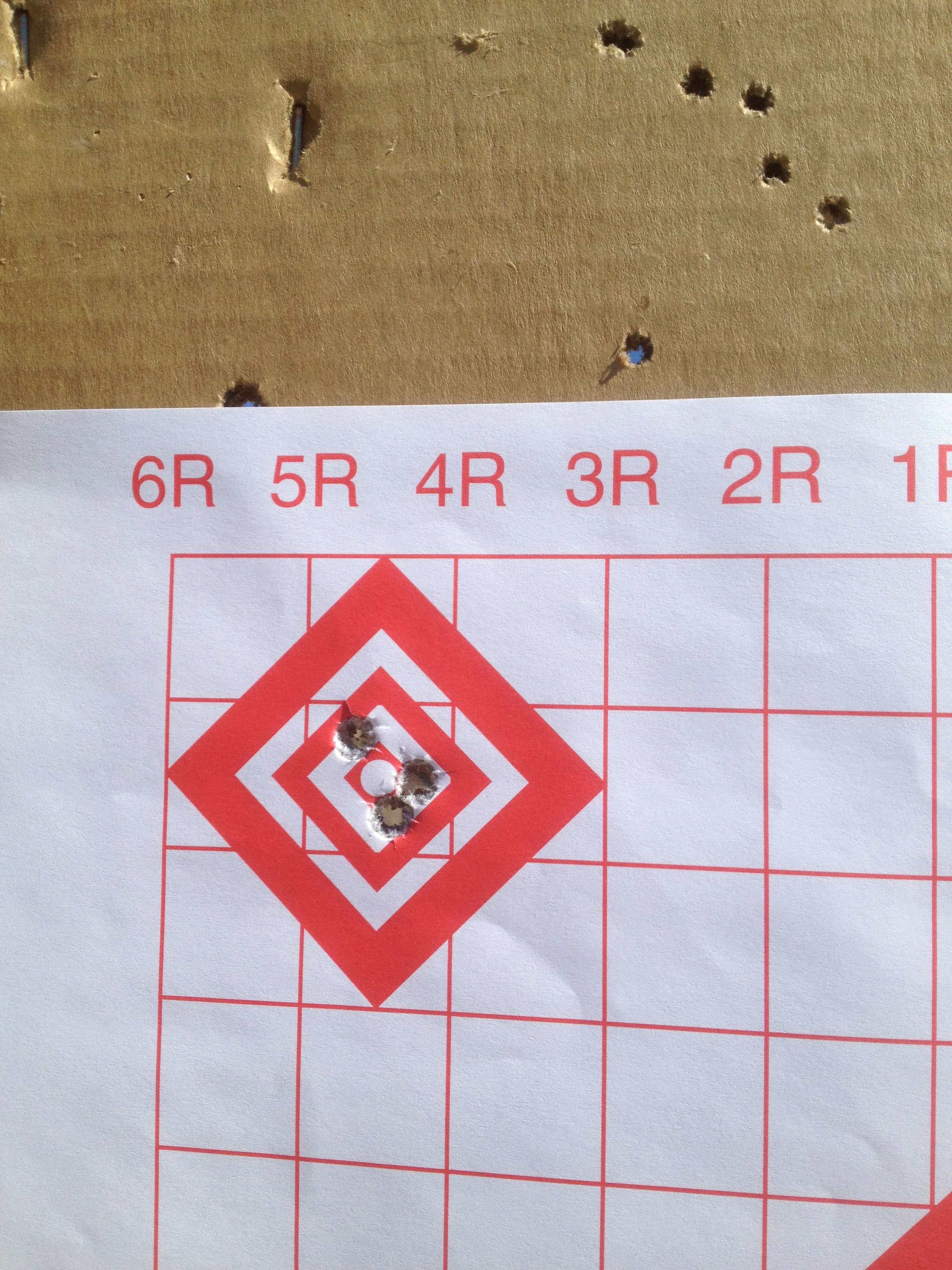
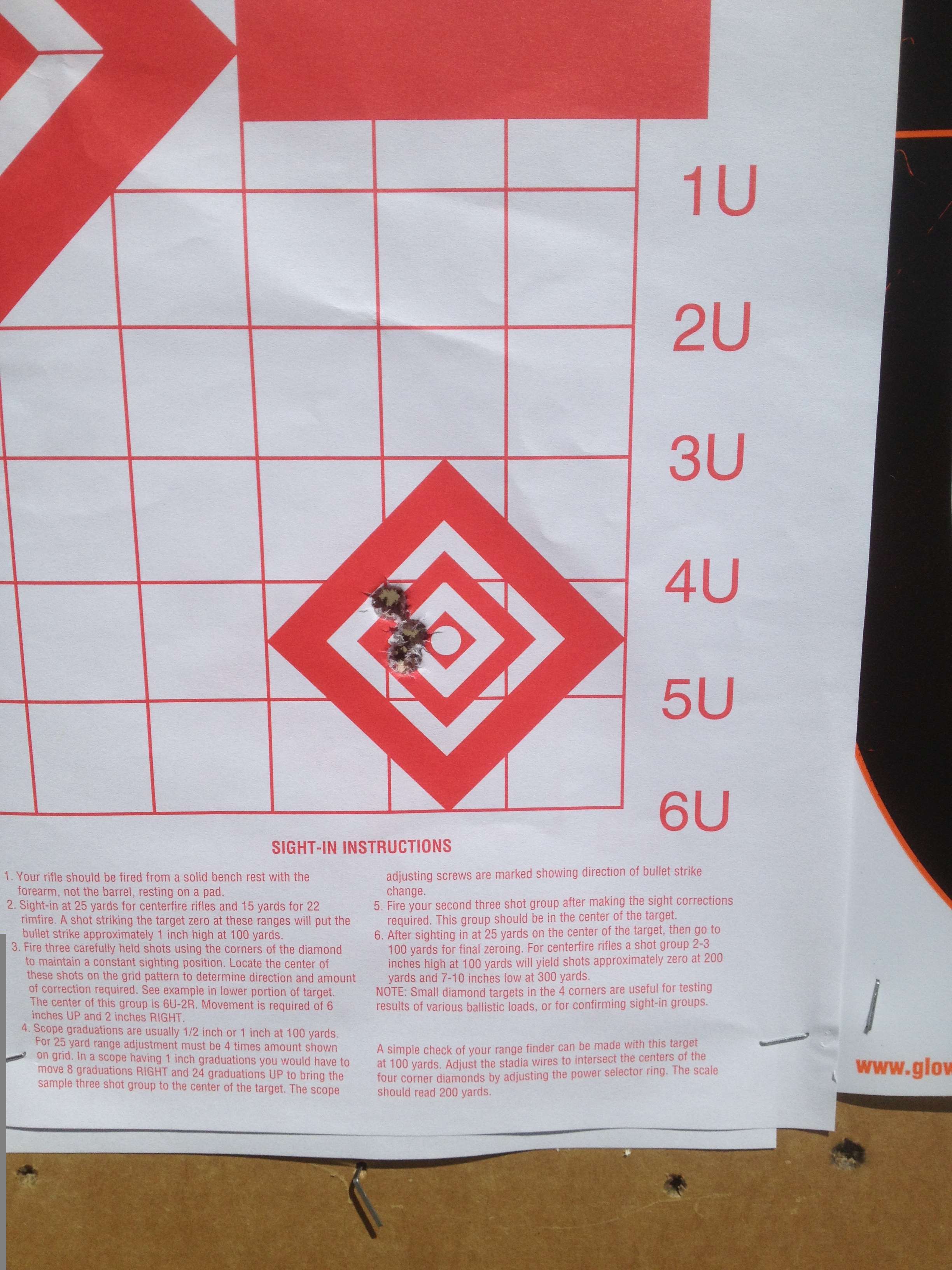
I like 3 shot groups . I feel it tells me what I want to know . The other day I was shooting a new rifle for the first time . I put 100 rounds through it over a 6hr period . what I did notice was I often had a flyer . I believe it was the third shot each time . I would shoot the first 2 and they would be touching and the third would be off a bit . Not much the group would still be well under 1 MOA just not all touching . do you all feel if I kept shooting the forth and fith shots the group would have kept on opening up ?

These were pretty typical of what the groups looked like
.
guns168.jpg

.
guns170.jpg


with this one being my best of the day and just so happen to be the first shots I took at 100yds
.
guns167.jpg
 
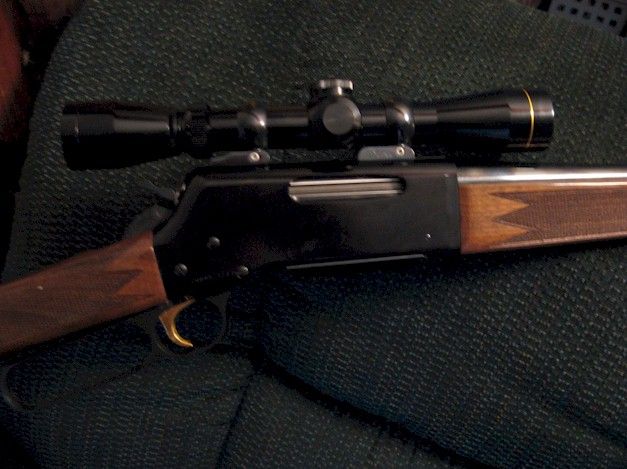
I am trying something new with a new rifle, a Browning BLR '81 in .308 caliber.

During the barrel break-in process, I left my usual cleaning paraphernalia at home, and only brought a bottle of Hoppes #9 and a .30 cal BoreSnake along.

Every three shots, I would let the rifle cool for a few minutes, then give it one pass of the BoreSnake, which would both clean the barrel, and cool it a little further.

Then three more rounds, at a different target dot.

I noticed that it started off shooting a 3.5 group, but by the time I had fired nine rounds, the group size had shrunk to @ 1.5 inches and stayed more or less the same throughout the rest of the box of shells.

I was firing Federal premium rounds loaded with 168 grain Sierra matchking BTHP bullets.

Next time I will be shooting handloads utilizing Hoirnady 150 grn flat-base spirepoints, as I have a large box of those on hand and have had good luck with them in other guns.

- But I intend to stick with the BoreSnake cleaning every three rounds for this particular rifle from now on. Even on a hunt, not just at the range. The small bottle of Hoppe#9 and the BoreSnake go into a ZipLock plastic baggy ( along with a microfiber cloth ) , and that goes into my pocket whenever the BLR comes out of the safe.

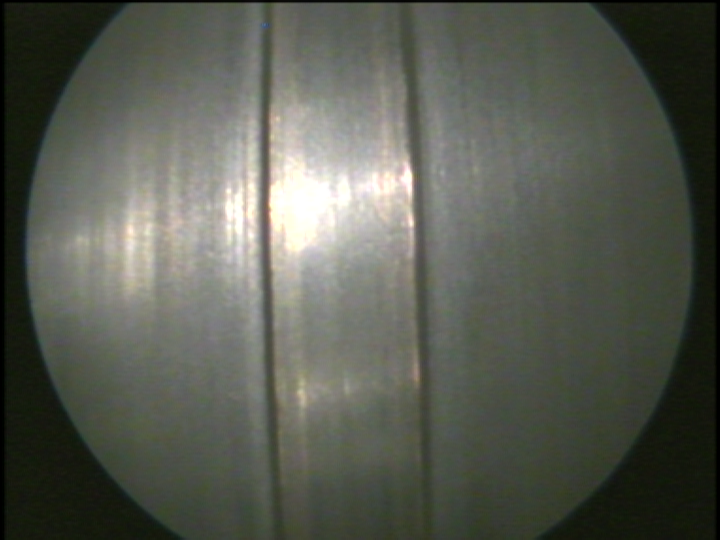
Here's boroscope image of the BLR's barrel after shooting that first box of shells.

2013_2_14_18_21_12_zps6925b22b.png


IMG_2834_zps81874330.jpg


The rifle has a nice, clean-breaking trigger that lets go at five pounds. I intend to try to get that down to 2.5 or 3 pounds and after that, I'll be done with working on the gun and will use it for hunting.

The new cleaning regimen is contrary to my established practice - but I intend to give it a fair trial with this BLR.

I agree with those who feel that the first three shots out of a clean barrel is what counts most for a big game hunting rifle.

 
I think it really depends on what variable your trying to isolate. If your testing ammo. 3-4 shots would probably do.
If your wanting to test the shooter. You'll need a few more, of course. The rifle? 10 shot groups are good.

My rifle will shoot a 10 round group at average of 1.15 MOA ( I still claim it to be a sub MOA shooter though ;) simply because with my hand loaded loads it ...it would be ;) Don't take that from me. This average includes factory loads

While load testing and picking the best loads I shoot 4 shot groups to find my loads (shooting 10 would get expensive) The best loads at 4 shots will yield me an average of .6" with bests being in the .275"-.4" range
 
brokenanew, with your stuff shooting an average of .6" with bests being in the .275"-.4" range, the real accuracy of your stuff's larger than .6". It's a bit bigger than the largest group shot with it. That's what all shots fired with that load will do. Only a few of them are down in the .4" and under range. But we don't know what the largest group shot is.

I know, it's a popular behaviour to talk about only the smallest groups shot. Benchresters have been doing that for over 60 years.
 
Let me ask this . What ever the number of shots in a group is 3 , 5 , 10 , 20 . Does the gun or should the gun be in some sort of vise to be an accurate test of the guns accuracy ? When you start shooting 10 and 20 round groups the shooter has to come in to play . I think I'm a good shot . Maybe even better then average . I can shoot 3 round sub MOA groups all day but I don't think I could shoot one 20 round group @ 1 MOA at any time of the day . I'm also of the thought that it's not a group unless you take one shot after the next . Maybe max time between shots would be 30 secs . 20 shots in 10 min seems fare . I would think with out a vise or mechanical rest one would have to be an exceptional shooter to shoot MOA with any rifle .
 
Shootings large strings to test true accuracy increases the chances of shooter error and change in environmental conditions, so shooting larger numbers in your groups doesn't guarantee better statistical accuracy. If ou can eliminate these variables then of course yes the larger the group the better.

however, I agree with a few other comments. Three shot groups tells me what I need to know. I have shot 5 shot groups before if i was testing consistency, but mostly 3 shot groups tell me what I need to know.
 
Wind and mirage conditions change often at our range, so I find that shooting several 3-shot groups, allows for barrel cooling and better groups. That's a better test of the rifle than shooting longer strings and waiting longer between shots.

Wind flags and knowing how to use them is a big factor in getting good groups on our range. We have berms between ranges that cause swirling winds, even downdrafts, at times. I use at least 3 flags.
 
5 shots have always been enough for me. Once i find a load that 5 shot's are tight,I do another 10 shots of same load and that's it. This shooting 100 rounds is a waste of time and ammo. The load is either going to work or not work.
 
Does the gun or should the gun be in some sort of vise to be an accurate test of the guns accuracy ?

No, test the gun the way you’re going to shoot it. If it’s a prone rifle, shoot prone. If it’s a hunting rifle shoot it like you would in the field. If it’s a BR gun, shoot from the bench.

I don’t care what my gun will do, I do care about what I can do with the gun.

If you are sighting in a hunting rifle, three shot groups are find. If you are sighting in a target rifle where you may fire 10 to 20 round strings, shoot 10-20 strings.

As to the cold bore vs. warm gun. Bart covered that here and in other post several times.

You don’t want a gun that changes impact, or at least I don’t. Two major causes is, as Bart explained is improper fit of the barrel to the action. We know metal expands when it gets hot. Nothing we can do about that. What we can control is consistency. If the barrel isn’t square with the receiver, you’ll never get consistency. If the action isn’t square, its going to magnify the error when it expands. The action has to be square with the receiver threads and barrel.

The action/barrel must be free floated or bedded where it doesn’t make or CHANGE contact with the stock when it gets warm and the metal expands.

When sighting in a rifle, or checking the accuracy of the rifle/ammo combo, write down everything about the conditions. Have or draw two pictures of the target. On the first picture or drawing call the shot and plot it. Do this before you look in the spotting scope to see where the impact is. Then plot the actual hit on the second picture/drawing.

I do not believe you can zero a rifle, or check for accuracy if you can’t call your shots. The bullet ALWAYS goes where the barrel is pointed. If you don’t know where the barrel is pointed when you pull the trigger, how can you determine your zero or accuracy of our gun/ammo combination?
 
One more thing:

Knowing your scope / sights.

You may have a scope with 1/4 moa clicks or .1 mil clicks. But are those clicks 1/4 or .1 clicks through out the range of the scope?

Very few people I've seen check this. Scope adjustments are noting more the a series of threads on the turret that move the cross hairs.

How do we know they move the same throughout the range of the scope? Fine treads like that on a scope arn't perfect and get worn.

Doesn't matter if its a good expensive scope or a cheaper model.

Take a four foot tall sheet of paper and put it on your target frame. Draw a line from top to bottom. (use a plum bob to make sure its straight up and down.

Set a target for an aiming point at the bottom of the target. Sight in on the target, then come up so many clicks and shoot again while using the same aiming point. Do this until you walk to the top of the target.

Now measure you hits to see if the shots match the number of clicks. If it does fine, if not, record the errors at what ever elevation you found those errors, keep the info in your data book for that rifle so you'll know when you start to move out to longer distances.

Do the same thing for your windage adjustments.

This gets a lot of people in long range shooting. That's why I like a zero for any distance I shoot, and not depend on Ballistic Programs to tell me where I should be hitting.
 
A cheaper, more accurate and easier way to measure scope adjustments is to mount a yardstick 100 (or 50) yards downrange at right angles to your line of sight. Clamp the scope in something solid aimed at the yardstick at one end with a reticule line on the yardstick. Move the adjustment for the other reticule line 20 major units, MOA or IPHY if so spec'd. See how many inches it moves on the yardstick. Remember your grade school math to figure out how much each major unit of adjustment moves the reticule.

I've clamped a scope on the vise on my basement shop's workbench and put a mirror about 50 feet away on the far wall of the family room to reflect the ruler on the workbench; a total distance of 100 some feet. Was easy to check my old Weaver T16 and T10 target scopes' movement per major adjustment.
 
Last edited:
Back
Top