
National Reciprocity - now in the Senate; plus other bills of note

MLeake

New member
According to POPVOX, the Senate has now introduced its version of the National Reciprocity bill; the House version was passed on NOV 16.
https://www.popvox.com/bills/us/112/s2188


There are also some other interesting bills listed:

The Straw Purchaser Penalty Enhancement Act (HR 4190)
Enhances criminal penalties for straw purchasers of firearms.
Weigh in at https://www.popvox.com/bills/us/112/hr4190

HR 3814
Prohibits the Justice Dept. from tracking and cataloguing the purchases of multiple rifles and shotguns.
Weigh in at https://www.popvox.com/bills/us/112/hr3814

The Gun Trafficking Prevention Act (S 1973)
Makes it illegal to traffic or assist in the trafficking of a firearm, including straw-purchasers who buy a gun for someone else (according to the bill sponsor).
Weigh in at https://www.popvox.com/bills/us/112/s1973

The Second Amendment Enforcement Act (HR 645)
Restores Second Amendment rights in the District of Columbia.
Weigh in at https://www.popvox.com/bills/us/112/hr645

The Second Amendment Protection Act (HR 3594)
Expresses the sense of the Congress that the U.S. should not adopt any treaty that poses a threat to the right to keep and bear arms -- and to withhold funding from the United Nations if it restricts or infringes upon the rights of U.S. individuals to keep and bear arms.
Weigh in at https://www.popvox.com/bills/us/112/hr3594
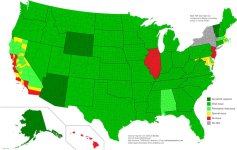
 
well I like that the pressure is on...

Hopefully the anti-gunners in Illinois correctly read the winds of change, give up the fight and focus on something else.
 
I don't like S1973.

IMHO laws that make it illegal to engage in acts that are already illegal are just plain stupid. Rather than enact yet another law that will be enforced selectively and sporadically, how's about just enforcing some of the 25,000 gun control laws that are already on the books?
 
In Illinois a felon in possession of a firearm only gets 2 to 10 or 3 to 14 years

They usually get 3 or 4 year sentences, which many times are meaningless because they're serving the same amount of time for some other offense anyway.

I'd like to see 3 strikes - 10, 20, 30 year terms for possession of a firearm by a felon, no plea, no early out, no parole, and served consecutively in addition to anything else.

But, instead of doing that - our federal government would rather spend billions on operations like Fast & Furious.
 
AB, I agree with you. I'm not endorsing all the bills I linked; those are just the ones that came with my auto-notification.

My thought process is, contact your rep or Senator not only about the bills you like, but also the ones you don't like.

M
 
The National Reciprocity Bill
If the Feds want a Nation Wide Carry Law then they ought to pass one. This Law is a direct interference in States Rights.
Do understand that I support the idea but not how its being done. The Federal Government can right nearly all the wrong gun laws just by enforcing the 2Ad.
 
As I understand it, the bill would cause the states to respect carry permits in the same manner they respect driver's licenses.

I hear a lot of Chicken Little arguments about it, but I have yet to hear one that makes any sense.

Quite frankly, the data is already out there if the Feds ever decide to build a registry; worrying about that is a day late and a dollar short.
 
I can't think of a good argument against a national reciprocity system. So many states already have reciprocity agreements with one another (either formal or informal), that a national system would serve more to "close up the gaps" than anything else - it wouldn't be a fundamental shift in the concealed-carry paradigm in the United States.

I know Virginia has reciprocity with 25 other states, and Florida has reciprocity with something like 35 other states, and the numbers are only going up. We can either institute a national system now, or we can wait 15-20 years until all the "onesie/twosies" eventually forge their own individual agreements. Personally, I'd rather see it taken care of now in one fell swoop.
 
Expanding on my previous post...

I am amazed that posters worry about a federal registry, yet they participate in Facebook, MySpace, etc. For that matter, they obviously participate in TFL.

If the Feds really wanted to get data, they'd get it. I have a hacker friend or two who could probably identify any poster on the forum within a day, two tops. Imagine what the FBI or NSA could do.

Better to get the laws we want, and keep the pressure on the government (all three branches) to prevent misuse of information and to protect Constitutional rights. Because, like I said, the data is already out there. It's only a matter of sifting and collating.
 
I was personally a fan of the "10-20-Life" law down in Florida. Its simple, if you rob someone with a gun automatic 10 year sentence. If you fire the gun automatic 20, if you hit someone 25-life. THAT is deterrence. No messing around, no bleeding heart judges letting hardened criminals back out on the street.

Like others have said, what are some of these bills supposed to do? Make illegal things illegal-er.
 
H. R. 3814 was introduced on 24 January, 2012 and has 29 co-sponsors.

http://www.govtrack.us/congress/bill.xpd?bill=h112-3814


S. 1973 was introduced by Sen. Gillibrand of NY in December, 2011. It has four co-sponsors, all the usual suspects.

http://www.govtrack.us/congress/bill.xpd?bill=s112-1973


S. 2188 was introduced on 13 March, 2012 and has two co-sponsors.

http://www.govtrack.us/congress/bill.xpd?bill=s112-2188


H. R. 3594 was introduced in December, 2011 and has 32 co-sponsors.

http://www.govtrack.us/congress/bill.xpd?bill=h112-3594


H. R. 4190 was introduced on 8 March, 2012 and has no co-sponsors. It was introduced by Rep. Adam Schiff (D-CA).

http://www.govtrack.us/congress/bill.xpd?bill=h112-4190

Text of bill:

http://thomas.loc.gov/cgi-bin/query/z?c112:h4190:


H. R. 645 was introduced in February, 2011 and has 173 co-sponsors.

http://www.govtrack.us/congress/bill.xpd?bill=h112-645
 
Last edited:
I wonder how we got all the states to recognize our drivers license?Was it done by the individual states of did the Federal Govt.get it done?My guess is that it was done by the Federal Govt. to make interstate shipping easier.Does anyone know for sure,and if it was the Govt. that did it,where are the so called problems?
 
Pbearperry said:
I wonder how we got all the states to recognize our drivers license? . . . .
By convincing states to enter into the Driver's License Compact, under signatory states agreed to recognize each other's DLs. There's no federal statute mandating recognition of another state's DL.
 
I hear a lot of Chicken Little arguments about it, but I have yet to hear one that makes any sense.
No bill that momentous will make it through the legislative process without having onerous provisions tacked onto it. If states like New York, Hawaii, New Jersey, Maryland, and Illinois can't kill the bill, we can bet they'll do their best to poison it. The result would be, at best, imperfect and riddled with loopholes.

Our path to nationwide reciprocity lies in the courts. We need a precedent (and we're getting there) acknowledging a right to carry outside the home, and from there, the dominoes will begin to fall.
 
Even if the reciprocity bill gets through the Senate without objectionable amendments added to it (and that's a very big if), I very much doubt that President Obama would sign such legislation.

As far as Nationwide Reciprocity itself, I'm kind of torn about the issue. On the one hand, it would be nice not to have to go through the legal hodge-podge when traveling from one state to another and I do think that the varied reciprocity agreements we have now make otherwise law-abiding people into criminals through no ill-intent of their own.

However, drivers-license reciprocity is more complicated than many realize and CCL reciprocity would be more complicated still. One of the reasons that DL reciprocity works as well as it does is that DL requirements and traffic laws are reasonably uniform from state to state. What differences do exist between the traffic laws of one state and another are fairly minor and most (such as speed limits) are clearly defined by road signs.

CCL laws, however, vary much more. Things such as minimum age, CC vs. OC, training requirements, prohibited places, requirement for inform LEO's, carry method, and even the type of gun that can be carried can vary greatly from one state to another. Also, the federal government does not simply sit back and allow the various states to write their traffic laws in whatever manner they see fit. A popular tactic of the feds is to withhold funding for road construction unless the states pass laws conforming to the fed's wishes. The last holdouts with seatbelt laws were finally pressured into passing them through this method as were states with interstate speed limits greater than 75MPH.

What I fear is that, once the feds get involved in individual states' CC laws, the nose of the camel will be inside the tent so to speak. The political wind can change direction quite quickly in D.C. and I'd rather have my state's CC laws affected by these changes as little as possible.
 
So it's a state's right, unless the state doesn't want to allow carry?

Or it's an individual right, supposed to be protected by the federal government?

It seems that some want to have it both ways at once.
 
So it's a state's right, unless the state doesn't want to allow carry?

Or it's an individual right, supposed to be protected by the federal government?

It seems that some want to have it both ways at once.


The reciprocity bill (if that's what you're talking about) won't force any states to allow carry. All it says is that IF your state allows carry, then you have to recognize permits from other states that also allow carry.
 
So it's a state's right, unless the state doesn't want to allow carry?

Or it's an individual right, supposed to be protected by the federal government?

That's putting a spin on things that isn't correct.

2A jurisprudence (the contours of the right) is in its infancy. It is an individual right. What all the carry cases are striving for is a recognition that it is our right to go about our daily business, armed for self defense.

The States are converting the carry argument to one of concealed carry. So far, the majority of courts are saying one or both of two things:

1. You do not have a right to concealed carry (a mischaracterization of our arguments).
2. The right to carry stops at the threshold of your home (the fact specific holding of Heller as opposed to the general holding).

The Peruta Court (SD CA) got it somewhat correct, in that this court found that since people are allowed to openly carry an unloaded handgun, then concealed carry could be regulated however the State wanted. In Richards v. Prieto (ED CA), this court held with Peruta.

The Ezell Court (CCA7) held that banning practice/target ranges, an activity that occurs outside the home, was unconstitutional.

Now we have the Woollard Court (D MD) and the Weaver Court (D WV) point blank saying that carry outside the home is lawful and part of the core individual right to carry for self defense.

It seems that some want to have it both ways at once.

Misplaced.

We are saying that the right to carry is central to the right to self defense. We are saying that the States may regulate the manner (Time-Place-Manner = TPM, ala 1A jurisprudence) of carry, but it cannot deny the right (regulate it into a non-right) altogether. We are saying that if the States wish to regulate all forms of carry, it can not do so in a discretionary manner, nor can it (the permitting process) be so onerous as to impede the right.

What I'm saying is that if the State wants to forbid open carry, it may regulate concealed carry, but not in a manner as to preclude the average citizen from the act of carry. If such regulations attach to concealed carry, then open carry must remain unfettered. There are any number of permutations that can be seen, using this as the standard.

Once we get this as settled law (via the SCOTUS, still 1 to 3 years away), then I wouldn't be opposed to the feds saying that states that have a permitting system, must accept other States permits.

It's not so much a matter of having our cake and eating it too, as it is one of setting the basic ground rules first. Until then, I oppose federal intervention in such State issues.
 
The thing is, the courts that are forcing the states' hands on these issues are federal appellate courts, or SCOTUS. The feds are already heavily involved, but it's the judicial branch, not the legislative.

Had this been left to the states, Chicago would still have a handgun ban, for example.
 
Back
Top