Low serial number 03 Springfield

So to pull one small risk factor out of the "shooting risk" and get obsess with it is a false if human reaction.

The real question should be is it a low sub set of risks in all risk factors

So RC20, what you're saying, I have driven my truck thousands of miles and not needed my seat belts so I don't need seat belts........I mean there are thousands of things that can get you, so why worry about seat belts.

Not buying it: I wont let my grandkids or wife in the truck without their seat belts and I won't allow a low numbered M1903 on any range that I run.
 
i own three low numbered model 1903 rifles, two Springfields and a Rock Island. Two of those guns are sometimes fired with reduced loads.

One of the contributing factors in the destruction of low numbered 1903 rifles was defective ammunition manufactured during WWI. National Copper and Brass made quantities of .30 caliber ammunition with soft cartridge cases. Much of the substandard .30 caliber ammunition manufactured during WWI remained in stockpile up to WWII.

Heres a good writeup on the low numbered 1903 rifles:

http://m1903.com/03rcvrfail/

A ruptured cartridge case in a 1903 Springfield, 1917 Enfield or a Winchester model 70 can be a traumatic event. Yep, a model 70 Winchester: i was present on a firing range when the beautiful pre-64 model 70 at the next bench was reduced to splinters and fragments when a cartridge case ruptured. Several of the shooters empty cases had incipient case head separations.
 
Last edited:
Having seen the aftermath of a blown-up receiver at the range (it was not a 1903) and a very lucky shooter that happened not to have his hand over the magwell at the time (or he would have lost it) I can't rationalize taking any chances with a firearm known to have even a slight chance of failure from a known manufacturing defect.

Seeing that guy bleeding from his right arm and face from shrapnel head off to the ER, and the rifle in pieces drove home the fact that these are literally controlled (hopefully) explosions at 60,000 psi that are happening inches from your face.

You decide...
 
So RC20, what you're saying, I have driven my truck thousands of miles and not needed my seat belts so I don't need seat belts........I mean there are thousands of things that can get you, so why worry about seat belts.

Not buying it: I wont let my grandkids or wife in the truck without their seat belts and I won't allow a low numbered M1903 on any range that I run.

No, you missed the point entirely.

Using seat belts (and I was an ardent and early advocate of those being mandatory use and used them myself, drunk or sober) is one of the ways I am trying to convey that MITIGATES the risk. It does not stop it, but it does reduce the chance of severe injury or death. Its the right think to do with as many air bags as you can get. However, you put far more risk to your whole family going to grandmas than having them shoot thousands of rounds out of a low SN 1903. Thats just the facts of life.

Don't drive drunk is another risk mitigator , but does not stop you getting killed or injured by another drunk (seat bags and seat belts may save you)

You are cherry picking the low SN 1903 risk from all other risks and making a mountain out of a molecule in the entire spectrum of risk we all face in living.

Somehow we all have to figure out how to live our lives. Assessing risk without the cherry picking one that says that I am risk free when everything what you do is fraught with risk and has a risk factor. Then choose to focus on reducing one very tiny tiny risk and claiming you are virtuous with risk.

I have had more than enough occasions where I have faced certain death or sever injury to be too familiar with it, some of it was plain stupid on my part and I was damned lucky or skillful enough to survive it (the guy who came out of an alley at 50 mph across the front of my Bronco that if I had been half a second sooner would have nailed me in the drivers door and killed me even with my seat belt being on (nor airbags in those days)

I live in Alaska and I see 15 air crashes a year where entire families die flying out on pure recreational trips. Is it worth it? How do you think the survivors feel?

Where does not shooting a low SN 1903 come into that? Marines fought Guadalcanal with NO reported receiver blow ups.

No blow ups reported after 1928. Hmmmm. Again I am not saying do it, but I am saying doing so has been conveyed as a Japanese suicide flight (certain death) to Okinawa in WWII vs the actual risk (close to Zero if you will pardon a pun)

However, its simply hiding your head in the sand to say it eliminates any real risk in the spectrum of your life. It does not. ALL things you do in life have a certain risk factor.

Being born has a definite risk, you will die. Its how you live in between and often how soon.

All firearms can fail. All shooting is a risk. I choose to do it, but I am aware of it. I sure not going to worry about a low SN 1903 in relation to every other risk I face in life that makes that one look like a grain of sand in a square yard of sand.

What about all the recovered drill rifles being shot that are severely comprised and on a guaranteed path to failure? How about all those other abused rifles that are about to go boom?

I will respect you if you do not, but I do not respect anyone who blows it all out of proportion to the real risk you face in just being alive and then says, I am virtuous and then tries to convince everyone else that is the path to virtue as well.
 
Again, I would like to see a properly documented case of a L/N M1903 giving way in the last 50 years or so. I have read of problems with some of the post WWII manufactured "M1903" receivers due to faulty manufacture.
Anyhow, nothing wrong with safe queens, that's what most of my milsurps are.
 
Where does not shooting a low SN 1903 come into that? Marines fought Guadalcanal with NO reported receiver blow ups.

No blow ups reported after 1928.

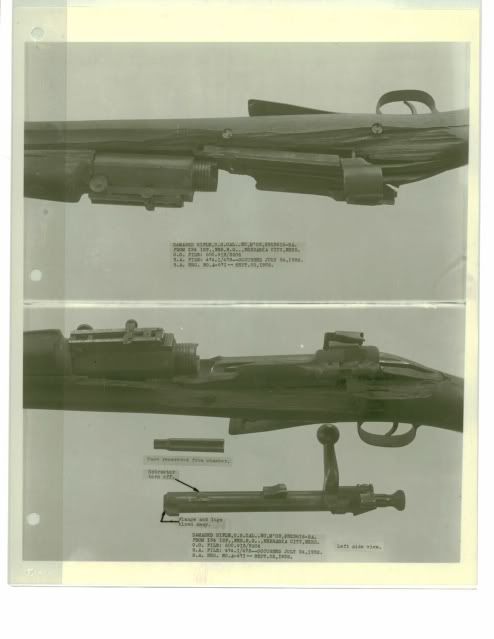
What makes anyone think that Hatchers list is complete? It is a listing of 03 blows ups from 16 July 1917 to 1929. The first receivers listed as blown up were a 1907 vintage receiver and a 1917 receiver. These receivers blew at National Brass & Copper Tube factory, a factory making ammunition for the US military during WW1. The 1907 receiver fragmented and blew a piece of shrapnel piercing the lung of the operator.

It is preposterous to believe that receivers had not blown before. What is more likely was that many receivers had blown, but to then Springfield Armory and its supporters were able to misdirect and muffle this issue, after all, who within the Army had the resources and records to argue with an Army Arsenal about its defective products, and what foolish Officer was going to ruin his career doing that? What made this event different and something that the Army had to acknowledge, were these blowups occurred outside of the Army chain of command. Springfield Armory did make up convincing sounding, but fallacious arguments: “cartridges cases not up to standard and secondarily, to receivers somewhat below the standard” but National Brass & Copper had qualified metallurgists, who could counter all of the self serving BS coming out of Springfield Armory. Plus, National Brass & Copper could go outside of the Army chain of command and complain to their Congressmen . This was not an entity that the Army could bury and ignore, as it obviously had done to date with all of the blown rifles that occurred before this event.

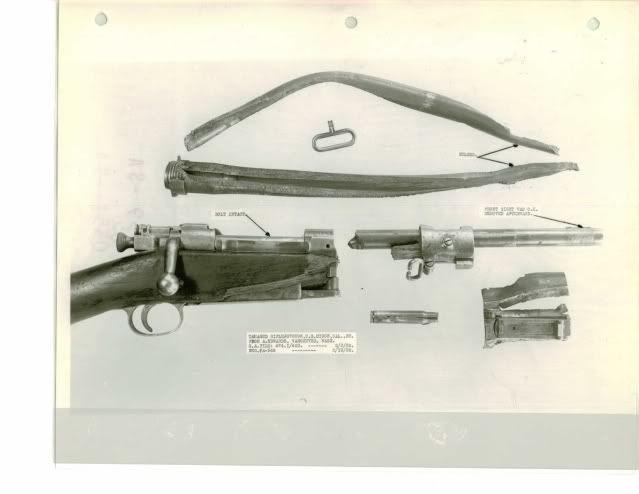
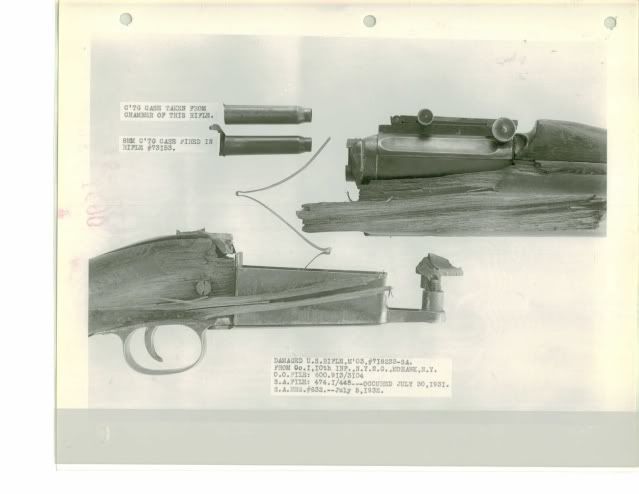
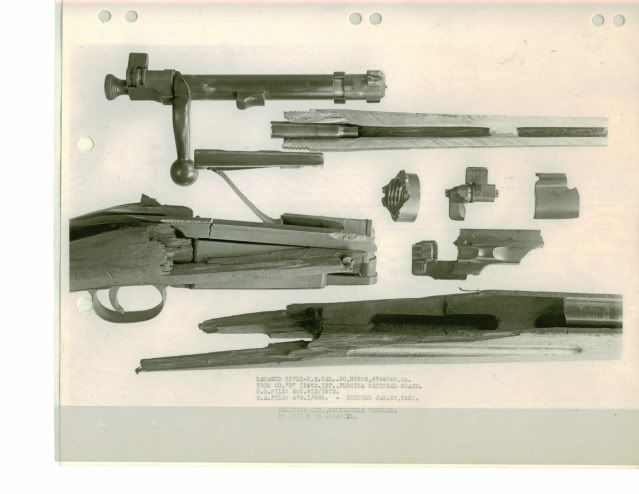
There are known blows afterward, proving that the laws of physics did not end in 1929, and also proving that any failure rates based on Hatcher’s Notebook are false, and any contentions that rifles did not blow up later are equally false.

Blown up 1932

Receiver 323816

M1903LN323816blownreceiver.jpg


Receiver 570, 095 Blown up 1932

M1903LN570095rupturedcaseblowsrecei.jpg


Receiver 718, 233 blown 1931

M1903LN7182338mmcaseblowsreceiver.jpg


Receiver 764, 040 blown 1931

M1903LN764040shatteredreceiver.jpg


It is remarkable that Hatcher had any reports at all. I don’t know how he got them, but he was Head of Army Ordnance during WW2. It is Army policy, nay, DoD policy, not to release Safety Accident Reports to anyone except Military Law Enforcement, and then, only if the law enforcement request is legitimate. I don’t know what you could get with a freedom of information act request, probably nothing of value since all you can do with a FOI is to ask, the agency gets to decide if the information “compromises” national security.

People expecting complete and accurate databases in the public domain from the Army for events that happened sixty years ago are unrealistic. Try to find similar information now. I am curious, where in the public domain the databases for all medical accidents, deaths, and malpractice cases? Where are the public domain databases of all lawsuits and convictions? . You can find sex offenders in your area, what about the list of all felons, all misdemeanors? What about the list of all fatal private airplane crashes in Alaska?, first I heard of 15 fatal per year.


In 1927 an appointed Army board examined all data and wrote a report recommending that all low number receivered rifles be withdrawn from service. This is recorded starting page 221 of Hatcher's Notebook. The board was over ruled by a Brigadier General who put out an incredibly irresponsible policy with the following logic “ Our ammunition is getting worse and accidents may be somewhat more frequent. On the other hand, some of these early rifles have been in used for many years and undoubtedly some of them have worn out several barrels. I do not think the occasion merits the withdrawal of the rifles of low umber in the hands of troops until the rifle is otherwise unserviceable

Let me add my comment, that BG decided that in between such time that the rifle wore out and was returned to depot, if that rifle blew up taking the hand or head of a Trooper, well that was just too damn bad. He decided that no Trooper is worth the cost of scrapping the complete inventory of rifles, in fact, no Trooper was worth the cost of a single rifle.

Times were different. But then, maybe that is how you feel about yourself.

It is true that not all single heat receivers are bad but the only way to find out which are good or which are bad is by firing them. Having been warned, that the entire population is suspect, that the failure is catastrophic, (look at the pictures here:http://www.jouster.com/forums/showthread.php?14045-Blown-03-Receiver-From-GB&p=136820#post136820,) if the SHT you are firing blows, don’t come back here and expect much sympathy. You were warned!

 
Last edited:
After WWII, when the M1903 was officially declared obsolete, there was no longer a central place to report any problems with those rifles and no effort was ever made by anyone to analyze any problems reported in the American Rifleman or the other gun/hunting magazines. There were some, but no one kept track.

Certainly I never reported the receiver I broke; DCM sent my friend a new NS receiver and that was all he cared about.

Jim
 
Last edited:
That certainly avoids the issue entirely!

If I found a low serial 1903 that was in good condition at the right price I would buy it in a heartbeat.

It would be a good idea to check it out and make sure its not a recovered drill rifle. A lot of the welds were lightly done and with a bit of grinding and coverings up you can't tell.

You also need to watch the re-barrel of the Model of 1917 Enfields (actually Winchester, Remington and Eddystone Model of 1917 per correct on the receivers) as removing of the barrel can crack the reviver.
 
It would be a good idea to check it out and make sure its not a recovered drill rifle. A lot of the welds were lightly done and with a bit of grinding and coverings up you can't tell.

A bud of mine bought a M1903A3 drill rifle action. Small tiny tack welds, I examined the receiver and could not tell if there were any welds and no heat discoloration.

However, when bud installed a barrel and shot it, the headspace kept increasing. He installed a larger bolt and shot it some more and the headspace kept increasing. He took the barrel off and the receiver was a curiosity when I looked at it.

What likely happened the guy who did the welding overheated the receiver and took out the heat treatment.
 
Back
Top