Looking for that perfect 1700 yard gun.

jboyette1984

New member
So i recently purchased a macth quality ar-15 in 6.5 grendel and im in love. Im doing very good at around 800 yards, but dont really want to go much farther with this cartridge esp for hunting. So i've been looking around for something in the 1700 yard range with still enough energy to take down elk sized game. Ive been doing research and i have some candidates but no experience with them. They would be the 338lm a SHF .50 bmg upper for an ar-15 lower. I considered the 408 cheytac but I dont want to spend 8 grand on a rifle. Are there any im missing or does anyone out there with a lot of personal experience with these have an opinion?
 
I would say your kidding yourself if you think you'll be lugging a 1700 yard rifle around to hunt anything. Beyond that how far can that animal move in the seconds its going to take the bullet to travel 1700 yards? More than enough to ensure it runs off and dies an agonizing death. Odds of us mere mortals hitting an elk in the vitals on a cold bore shot at 1700 yards would be lucky even for the best shooters in the world.
 
Where is this nonsense coming from?!?

The ethical limit for hunting shots is about however far your bullet can fly in a 1/2 second. And farther than that and the animal can and will move unpredictably during bullet flight and could easily end up gut shot.

Generally that equates to about 400 yards for magnums, 300-350 yards for non-magum bottleneck hunting cartridges, and potentially less for really slow things like .45-70s.

Of course, there are other limits - the accuracy of your rifle and wind doping, energy on target, minimum functional velocity for the bullet you're using etc. But even if all those are OK, the limits above still apply.
 
Last edited:
The way I see it is if your so good at 800 with the grendel that your bored with hitting 4" targets every time, inside 300 yards you can be as precise as you need to be too put an elk down with the 6.5 Grendel way more ethically than lobbing bullets at an animal a mile away.
 
You mentioned having a Savage in 338 Lapua in a different topic...

Any reason you aren't seeing how far you can shoot with that before making a decision on a new gun?
 
Last edited:
So i recently purchased a macth quality ar-15 in 6.5 grendel and im in love. Im doing very good at around 800 yards, but dont really want to go much farther with this cartridge esp for hunting. So i've been looking around for something in the 1700 yard range with still enough energy to take down elk sized game. Ive been doing research and i have some candidates but no experience with them. They would be the 338lm a SHF .50 bmg upper for an ar-15 lower. I considered the 408 cheytac but I dont want to spend 8 grand on a rifle. Are there any im missing or does anyone out there with a lot of personal experience with these have an opinion?

The ethics aside, because the ethics have been clearly addressed by Llama Bob, there remains the ballistic considerations.

Pushing a 300 MK to 2,750 fps the 338 Lapua will drop below 1,000 foot pounds of energy past 1,500 yards.

The 50 BMG pushing a 700gr M2 ball at 2,750 fps will still have 1,700 ft/lbs of energy at 1700 yards. But it's a three second time of flight to get there. Even upping the velocity to milspec 2900 range only decreases the time of fight to 2.9 seconds and bumps energy to 1880 ft/lbs.

But then you get into the accuracy problem with bullet instability in the transonic velocity zone, which you could address a bit by using something like the 750 Amax bullet to some extent.

If you get a 50 BMG upper for an AR-15 lower, you will not enjoy the recoil. Everyone I know who went that route ended up selling the 50 BMG upper because of recoil. Just not pleasant to shoot for any length.

My personal recommendation is not to hunt at long range, but if you are looking to get into the long range target game get started with a 300 Win Mag pushing a transonic stable bullet like the 220 SMK or 230 Berger Hybrid OTM. Sure you could get more muzzle velocity out of a 30-378 Weatherby or 300 Rum, but it is simply not necessary to go that overbore.

I know it's a free country and you can do what you want, but being an ethical hunter is being a good representative for all hunters. If you want to drop animals at long range just to test your skill, varminting is a much better choice than big game hunting. Varmint covers a lot of range, from prairie dog to feral hog and people are generally happy with a reduction in the pest population.

Jimro
 
The whole thing about hunting deer and elk is to recover as much of the animal as you can. I have been places where the elk have stayed in the same position for minutes so a three second travel time when these same animals are accustomed to hearing low flying jet aircraft and sonic booms would not be a problem. The problem would be the mess that .50 cal round would do to the carcass.
 
I'm not opposed to shooting game at long range if the shooter and equipment are up to the task. There are lots more game animals wounded or missed with shots taken at under 50 yards than over 500. Lots of people shooting at 50 yards that can't shoot, most who attempt 500+ know what they are doing.

That said, 1700 yards is being unrealistic. I've read of hunters successfully making shots at 1200 and know several people who are good enough to ethically take the shot at 700-800 yards. Any rifle with the power and accuracy to do the job farther isn't something you want to carry around hunting.

The military gave up on the 338 and settled on 300WM. With better bullets it'll get you well over 1700 for targets and to 1,000 for game. I'd be looking at one of the 300's in a quality bolt rifle.

Generally that equates to about 400 yards for magnums, 300-350 yards for non-magum

This is nonsense:

Hunters routinely take game at well over 400 yards with non-magnums. Just about any hunter who can make shots at 50 yards can hit at 300-350 and everything from 243 up has power to spare at 300-350 yards. There are no special skills or equipment needed until you start approaching 500+.
 
Since we are sharing opinions on this subject: Here is mine.

The fact that some 'hunters' take game at 500 yards plus does not equate into the practice being somehow related to good sportsmanship.

If you've convinced yourself that it does, well there is the real nonsense.

There is nothing sporting about taking shots at game animals so far away that they could not detect your presence if you jumped up and down and waved your arms.

These discussions were very rare on gun forums, not so long ago - until the movie "American Sniper" came out.

I have a clue for everybody who has seen the movie: Game animals are not varmints. They are not terrorists. They are not pieces of steel. They are fine game animals, and a sportsman respects them. Part of that respect is to man up enough to be utterly unwilling to take a gamble on injuring or losing one through your actions in the field.

If you are not up to that standard, then you are not a sportsman or a hunter, you are instead a 'long range game shooter'. - And that ain't much, brother.

To be a 'long range game shooter', disrespect for the game you hunt, and indifference concerning the harm your actions do to all hunters is just a beginning. There must be a strong combination of self-imposed ignorance, indifference and arrogance, in order for one to be a long-range game shooter.

Ignorant enough to ignore the fact that the further one shoots at a live target, the less control you have over the outcome - and the fact that as distance increases, your ability to track, find and put down an injured game animal increases exponentially. - Ignorant enough to ignore the fact that the ability to do this reasonably soon is effectively zero. Ignorant enough to think that since steel plates do not suddenly decide to move as you shoot at them at long range, that game animals will not move, either.

Indifferent enough not to care.

Arrogant enough to think that you are exempt from the laws of physics, the basic tenets of good sportsmanship, the work of Murphy, and of course the proven fact that a game animal, unlike a steel plate, is unpredictable and is liable to suddenly decide to move at any time.

Ignorance - Indifference - Arrogance:

These are the components that make up the difference between an intelligent, responsible sportsman - and the despicable 'long-range game shooter' who has no business whatsoever in the game field with men and women of good character.

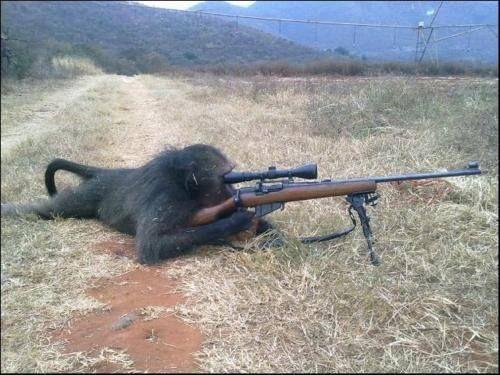
monkeyrifle_zpszrnmpjtx.jpg
 
Last edited:
Hunters routinely take game at well over 400 yards with non-magnums. Just about any hunter who can make shots at 50 yards can hit at 300-350 and everything from 243 up has power to spare at 300-350 yards. There are no special skills or equipment needed until you start approaching 500+.
You missed the point. The issue is not whether you can "hit". Hitting a point in space at 400-500y is easy assuming you have a decent rifle and a pack to rest it on. Energy is likewise generally not the issue with most loads.

The issue is the movement of the animal. And there is no skill or equipment you can have that keeps your deer from taking a step forward so that the bullet previously aimed (accurately) at its lungs now passes through the gut.
 
This is a tough subject, I tend to agree with the Don't Do It camp. I also don't find it very sporting to take those long shots at game. My problem with it is after the shot, when you walk that mile to where the animal was standing will a person even be able to locate the spot to begin tracking? I sometimes have a hard time pinpointing that spot after a 100 yard shot. I will search for sign of a hit for hours before I decide I could have missed. The animal deserves that much. At that long range in just not sure that you could ever find the spot to start looking. That said, a rifle capable of that shot would be awesome.
 
I've got a cardboard, life-sized elk target I like to take out to my "place" to shoot, and I set it up at 320 yds. Usually, I'll just take 3 shots at it and am satisfied to say my '06 will put them all in the heart/lung area when I do my part. I just lay prone and shoot off of my daypack, as I would if I was shooting at an elk that I had time enough to set up a shot, and shoot that way. It's good practice, and I usually do it at least once a month through the "off" season. That range is about my maximum, though if the conditions were absolutely "right" in my mind and heart rate, I'd feel confident to push that bullet a bit farther. I absolutely use a range finder, too, when I'm hunting. I've lived and hunted in Wyoming for the past 37 years, and other than a couple of antelope, I've never shot anything over 350 yards, and that's a long way out there for me. I don't hunt antelope anymore, either.

A good friend sent me a video a while back, and with all the hoopla about the long range phenomena around and in the shooting world these days, he knew it would get a rise out of me. The video is obviously an ad for a rifle company, and it's of a young gal shooting a cow elk at just under 700 yards with a .243. Of course, they had a close up of the elk when hit by the 100 grn. whatever bullet used. What I saw in this video, was the elk being hit in the spine, right over the hind quarters (IMO), and of course, it went right down, the hind legs buckling under first.

Before they took the camera off the elk, you could see the front leg jerk a bit. That elk, to me, was not dead by any stretch. For the rest of the video (which wasn't long) they (the shooter/spotter/video group) sat a laughed and talked about what a great shot the girl made and seemed as if they didn't have any thought of taking that half-hour walk to take care of that cow. A .243? At 700yds.? Really? And, if that elk was hit where I thought it was (again, IMO), that was not a good shot; just a lucky "scratch" one, on that unlucky cow. I would imagine the girl had some shooting/training/coaching time well before the hunt they were on, but what are folks supposed to take away from the video anyway? Hopefully not that a .243 is good medicine for hunting elk at long range. It also sounded like the wind was blowing fairly well during the video, too; not good for a 100grn. bullet at 700 yds. (IMO)

One thing I do know about elk hunting, is that sometimes when an elk is hit, and hit good, it shows no sign of being hit at all, even with a proper elk rifle and hand load.
 
Ethics isn't a topic we should preach to others, but a discussion that should be had. It has nothing to do with caliber used, energy, nor time of flight to target. Fieldcraft is important part of hunting and shouldn't be ignored just for the shooting aspect. However, once you squeeze that trigger it is no longer hunting, but shooting.

1700 yards or let us just say one mile is a long ways, but I'm not about to preach shooting game at that range shouldn't or can't be done. However I think you should go visit the Applied Ballistics web page and use their ballistics calculator. Pay special attention to the Weapon Employment Zone and look at your chances of hitting a target with a "High Confidence" shot at a mile, you only have less than a 28% chance of hitting your target.

Remember having good ethics isn't about doing everything right, but doing the right thing when things go wrong. At one mile it's very hard to do things right, so you better be prepared to do the right thing. Shooting a mile also can't be done alone, find someone to work in tandem with to try and accomplish your goals. I'm sure by the time you're able to shoot with high confidence at a mile, the chance of you taking a shot on elk at a mile will be 0%
 
This is the type of stuff that will get hunting banned or much more regulated in the future. There are other ways to prove your manhood than taking a ridiculous shot at a poor animal that far away, they deserve more respect than that.
 
I've shot steel targets at 1700 or so yards. In perfect conditions when I have a lot of time, I miss a lot more then I hit.

Can you judge wind?

Can you tell the difference between a 5 MPH wind at 1700 and a 6 MPH wind?

At that distance, its a of 15 inch difference. Shooting steel you might be able to see dust from the miss and adjust for a second shot.

Hunting animals its a miss or worse a wounded animal. A wounded animal can travel a long ways by the time it would take you to hike 1700 yards to where you thought you saw the animal.

Long range shooting is a lot of fun, I've done enough to know I'll stick to steel or other targets. I respect animals too much to attempt to hunt them that far.
 
On January, 6 - you were looking for an optic for a Lapua 338. That rifle will shoot 1700 yards...or, did you give up on the Lapua 338?

You've claimed you've shot to 800 yards. Fine. Try 1,000 and see what happens.

I shoot a gun that makes 600 yard shots easy - you can hit every single shot if you can do the wind drift compensation. Nearly anyone using the gun can empty a 20 round magazine into a 10-inch target as fast as they can pull the trigger. The gun and the scope, shooting from a bench rest, are just that good.

The same gun will make shooting 800 yards doable on a regular basis - if you can do the wind drift compensation.

Now, you get to 1,000 yards. That extra 200 yards - and it's a whole different level. At 1k yards and beyond the wind speed changes several times (and sometimes direction) over that distance. Even on good day - 90% on an 18-inch target takes some real work from a bench rest.

Why? It's not just the wind, it's the optics over that distance. I use a custom scope from US Optics built to my requirements. But, no scope will take the turbulence out of air.

If the sun's out - you have heat turbulence regardless of temperature.

Now, you're contending with magnification to see the target - and that magnifies the turbulence + you still have the wind drift over the 1,000 yards.

I use a 25x at 1,000 yards and it just makes hitting an 18-inch target doable.

For 1700 yards, you're going to need at least a 40x or maybe a 50x optic to see the target adequately. By that I mean, you can find the spot you want to hit - and more importantly, you're CONFIDENT of what you're seeing.

If you don't think you're going to be see a whole lot of air turbulence making the target shimmer and move - you've no idea what happens to the air over that distance.

Go buy a GOOD spotting scope and setup a 1700 yard target. Look at it under a variety of conditions at the magnification you're going to have to use for 1700 yards. Take your time. Critically evaluate the target and the image.

The target will be moving around and not sitting still - and then there's the wind drift over the 1700 yards. Multiple directions and wind speeds. See if you can CONFIDENTLY see the wind drift and wind changes over the distance. Can you see the wind speed changes? How much are they? What's the effect on drift compensation? Can you see the wind direction changes? What will that do to your compensation?

So, you really are the super shooter and have done the mental compensation and you know the wind drift compensation. You still have a moving target due to turbulence + magnification. Now, you have a moving reticle (no matter what the rifle base) as your heart beat will be moving the gun and you will see it at anything above 20x.

Moving air = moving target + moving reticle no matter what the rifle rest.

So, you think 1700 yards is simply double the 800 yards you claim you've shot? You've never even looked carefully at 1700 yards or you wouldn't be making such a ludicrous post on a public forum - or, you're way over estimating your shooting ability - or both.

You'd better have a really good spotter with a really good spotting scope who knows how to call adjustments - because doing it on your own will be extremely difficult, if not impossible.

Frankly, you really shouldn't be attempting any kind of hunting at 1700 yards because there is a whole lot more that goes into that kind of shot than what you think.

No one should be contemplating that kind of shot outside of a life and death situation - and hunting doesn't qualify for that definition.
 
Back
Top