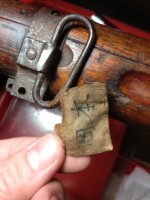
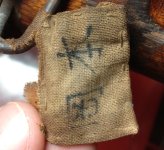
Japanese Arisaka-Early Type 99 Cloth Tag

IronSights85

Inactive
Hi everyone,

I'm new to the forum and have a question on an early Type 99 (Series 3) that I have recently acquired. It has a cloth tag on the front bayonet swivel and I have heard a lot of conflicting answers as to what it reads. Looking forward to hear some thoughts and answers. Thanks!
 

Attachments

  • photo.jpg
    photo.jpg
    144.3 KB · Views: 98
  • photo3.jpg
    photo3.jpg
    208.6 KB · Views: 84
the only 2 explanations I've seen is it was family name, placed there upon surrender so that the victor would know the names of his vanquished enemies or...

...it's a prayer
unless you know someone proficient in Kanji then you probably wont find an answer to it. and also it's a sling swivel not a bayonet swivel.
 
Everything I've ever seen indicates that they are name and rank of the person who turned it in.

These will occasionally show up on swords and handguns, as well.
 
I was also researching a bayonet at the time I posted, so I let that slip in there.

:D I do that often. You should see what I write if I'm researching two different guns at the same time.

I'm with the "name and rank" for the cloth tag. It's a special touch.
 
Pure speculation now, but if your reading is correct, someone with that name probably would have been a Chinese conscript.
 
I wouldn't be able to speculate too far into that, but what I can tell you is that good old Google Translate says that the "Han" part is also Chinese.
 
Many Arisaka's were used by the Chinese during Mao Zedong's revolution. I had a Type 38 with Chinese characters on the buttstock. Could explain the Chinese.
 
I'm not sure how it would affect translation, but the Japanese adoped many of the Chinese pictographs, or Kanji, and over the years many have come to mean something completely different between the two languages.
 
I trust the program I used a fair amount. I'm leaning towards agreeing with you guys on it likely being a conscript, but I obviously can only tell you what the program tells me because I don't speak Japanese/Chinese.
 
As an aside, wouldn't you love to know the whole story about that rifle?

I know I would. Every time I see someone show up at the range with an M1 or a Springfield 1903, I wonder where those rifles have been and what they were witness to.

Every nick and ding in the steel and wood has a story to tell. . .
 
As doofus47 pointed out, it is a Japanese name. Okamoto is a fairly common Japanese name at that. And yes, the Japanese adopted the Chinese pictogram alphabet centuries ago, and pronounce the words differently than the Chinese, but retained their original meaning.
 
"but retained their original meaning"

Not quite true.

By the time of WW II many of the original Chinese meanings for the pictograms had either fallen out of use and had been replaced with uniquely Japanese definitions (for lack of a better word), or retained the original Chinese definition and had a supplemental Japanese definition laid over top.

It's similar to the differences in US vs British English.
 
Mike's right, and it's quite an interesting story (as are most language stories).
The Chinese characters were first imported into Japan with Buddhism back in the 5th Century or so (my memory fades). For some ideas (ideas of governance, Buddhism, history, etc) the Chinese words fit precisely or the words were imported with the letters.
When the Japanese tried to apply the Chinese characters to convey the complete scope of the Japanese language, they ended up shoe-horning the chinese characters into local useage by adding hiragana letters to start a word with a Chinese character and finish with a Japanese letters to complete the local pronunciation an useage. Most kanji have both on (Chinese origin) and kun (Japanese origin) pronunciations depending upon their use. Similar appropriation took place when the Akkadians took over cuneiform from the Sumerians: a lot of the glyph designs remained the same, but the pronunciation changed and supplementary glyphs came into being.

Moreover, since the Meiji restoration in the 19th century, there have been a couple major revisions for simplification of the Chinese characters used in Japan as reading became less about status and more about education of the general population.

Then there is the Meiji construction and names. A whole lotta Japanese serfs didn't have official family names until the end of the feudal system of governance. A lot of "new" family names used semi-geographically descriptive. Okamoto? I'm betting your great-granddad lived at the base of the hill (not a hard trick, since there lots of valleys in Japan). Nakamura? I bet your family used to live in the village... So given the relatively short amount of time between the Meiji and the end of WW2, I'd bet that Okamoto was probably unchanged.

The most interesting thing that I noticed when comparing Japanese and English root words (in a completely unscientific manner in my own mind) is that often in English we have a basic understanding of what a word is about by how it sounds. For example, "hydro-power, hydro-dynamic, hydro-X) is going to involve water somehow and 90% of the time we're right. We might spell hydro very creatively, but the idea remains the same when conveyed aurally. In Japan, there are lots of words that sound similar and their ultimate meaning might remain vague until the confused party can see the kanji. Homophones abound. Now placenames? You could show any well-educated, erudite Japanese the name of a random unknown village written in kanji and if pressed for a pronunciation, they would probably say "I"m not sure, but... it could be...." b/c local dialects gave towns all sorts of odd, one-off pronunciations.

cliff notes: names usually take Japanese pronunciation. Other words, maybe.

edit: to keep this on topic, descriptions of gun parts and terms involving firearms are usually Chinese kun pronunciations

 
Last edited:
And I thought Engrish was velly velly skrood up... :p

Anyway, my apologies for dragging the thread off topic, but thanks for the much better in-depth explanation, doofus.

In any event, I'd say that it's definitely a surrender tag, but there when the guns were collected and handed over to Allied troops.
 
Oh, and someone mentioned that they thought that the tag might have been put there by the Chinese Communists after World War II.

The Chinese did have available many Arisakas and other Japanese weapons, but did the Chinese ever sell any of those to the United States for the surplus market?

I don't recall ever seeing any indication that they did so, and personally I would suspect that the Chinese scrapped most of those firearms for the excellent quality steel to be melted down and put back into SKS and AK rifles.
 
Thanks for all of the replies! I got this rifle from a WW2 vet who brought it back with him right after the war ended. I also got a Trainer Bayonet (another post I made). He kept them in his attic all of these years.
 
Back
Top