
accuracy from a 30-30 lever action

TheBear

New member
Hi

What kind of accuracy can i expect from a scoped 30-30 lever action rifle (Henry, marlin, winchester, something like that) shooting hand loads with cast bullets (with and without a gas check)?
And please dont give me any "only doable if youre a super-pro with a custom rifle" numbers. Im an average shooter and im not planing on tuning my rifle.

3 shot groups at 100 yards??
 
With factroy loads and a low powered scope 3" should be easy enough for most rifles. The guns themselves vary a lot. Winchesters have been all over the place as to quality over the years. Most should give you 2"-3" groups at 100 yards. You do run across a few that struggle to keep 3 shots in 4-5", but that is unusual.

Marlins have been more consistent. You are more likely to find a Marlin that will shoot 1" or even a little less. I'd say a typical Marlin will be in the 1"-2" range.

This is with factory loads. I see no reason to expect good handloads to be any worse and possibly better.

No experience with any other brands.
 
Exactly what jmr40 said. At its best, using 150 grain handloads, my winchester 94 with a weaver 1-3x can keep 3 shots within a 3 inch circle at 100 yds. Some people claim that the longer barreled '94's without the barrel/magazine band can do better. I don't know.

My .35 rem, 336 marlin seems to do better than my winchester '94, using jacketed bullets in both, but that could be due to individual differences between rifles.

As for cast bullets, the marlin micro-groove rifling might not be as good as the regular ballard type.
 
When I'm "on my game", I can routinely get three shot groups @ 100 yards measuring 3 1/2" to 4", from a sand bag rest, with my Model 94 carbine using a Williams FoolProof receiver sight.
 
I think JMR40 may be a tag generous. I would say that the 1" shooter -even a Marlin is a pretty rare animal. I'd agree with most being about 2-3".
 
Part of the problem with using iron sights on a lever carbine is the sights that came on the carbine. My Win 94 front sight subtends 9" at 100 yards. For target work, it's best to use a good black bullseye and a 6:00 hold, and on good days, when the temps are pleasant and the wind is calm, I can keep my shots in less than 4" at 100 yards. On those other days, I can keep my shots inside that 9" circle that my front sight covers. In fact, that's what I'm trying to do, because I sight my lever guns to shoot into the area covered by the front sight.

Put simply, when I'm cruising the woods, I want to be able to shoulder the rifle, cover my target area with that front sight, and know that my bullet will fall somewhere in that covered area, whether I'm shooting at something 25 yards away or 100 yards away. It's not the best for precision shooting, but it works very well for quick shooting.

Both of my Win 94s carry Williams Foolproof peep sights. The cast bullet I like best is the Lyman 311041, pushed to about 1850 fps. I cast it from my linotype alloy, gas check and size it to 0.309, and double dip it in liquid alox. It never fails to satisfy.
 
If you would use the top of the front sight instead of the whole sight, you would have a lot better chance of accuracy at a distance. If you use a Marlin with standard rifling instead of Micro Groove you could probably pull some decent groups with cast bullets. Under 3" should not be a problem, but using the whole front bead covering your target, you might as well tie one arm behind you first as a handicap.
 
I have a Savage M-170 pump gun in 30-30 and a Winchester 94 they both print right at 2"-3" @ 100 with my handloads (Sierra 150 Pro-Hunter & 33 grns BLC-2).
That's plenty good for deer & bear @ 150 yds & less in my Coastal woods.
 
I think JMR40 may be a tag generous. I would say that the 1" shooter -even a Marlin is a pretty rare animal. I'd agree with most being about 2-3".

I may have not explained it well enough. A 1" lever gun is rare, but what I was trying to convey is that you are more likely to find a Marlin that will do it than a Winchester.

I've seen a lot of Marlins that would be under 2" with a scope, and many closer to 1". Not many true 1" and under guns though.
 
With handloads, the accuracy will depend all much on those as anything else.
So, it's going to be hard to say how they will perform.
You will have to do some experimentation, especially with the bullets.
Even small differences in diameter and length will have effect.
All part of the fun.
 
Properly sized cast bullets (proper match to the individual bore) can be very accurate. Velocities MUST be held to limits matching the bullets used.

I wouldn't push even hard cast bullets in a rifle beyond 2000fps without gas checks, and 2200 is considered the usual top end even with gas checks.

Softer slugs can't go as fast without unacceptable lead buildup. Cleaning a lead fouled bore is a real chore, so use care with bullet construction and loads.

The .30-30 is able to be loaded to basically full power with properly made cast bullets, but that doesn't mean every cast bullet you can put in the case is suitable for full loads. Personally, I would keep non gas check loads below 1800fps until you see just how the particular bullets behave at that level.

The two basic issues are bullets too soft for the speed leading the bore, and bullets hard enough not to lead the bore doing it due to hot gas melting the bullet base (which gas checks prevent). Bullets soft enough you can make a clear mark on them with your thumbnail are not suited to top speeds.

Also, loading cast bullets in rifle cases is best done using an expander die to flare the case mouth slightly. Not flaring the case mouth often means the cast slugs are damaged during the seating process. While an expander die is standard for straight walled cases, it isn't for bottle neck cases, and you would need to buy one for loading the .30-30 case.
 
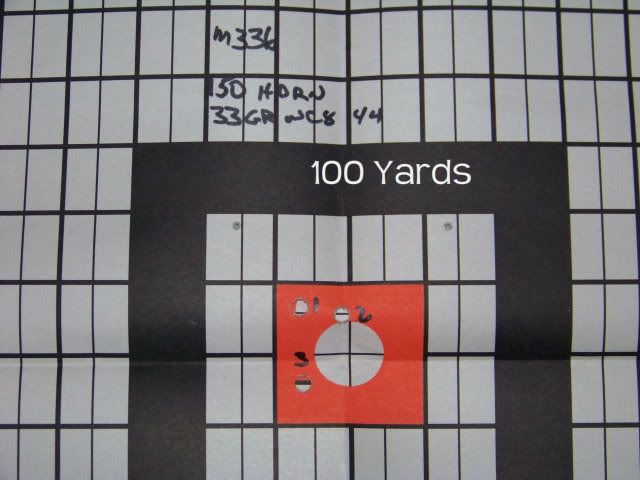
This is about as good as we have been able to get out of my Marlin 336 at 100 yards
Be advised though this is a 1958 vintage Marlin with Ballard rifling and a silky smooth trigger.

100_8543.jpg
 
Last edited:
We have well over dozen 94 win's in the family and all of them shoot between 2-4" groups at 100 yrds. My 100th anniversary with about 500 rounds through it shoots 2" scoped and my dad's pig gun with it least 10,000 rds through it after 50+ years still shoot 4" groups with open sights.

94 win's generally shoot cast bullets a little better than the 336 but a good 336 is probabilly a little better quality rifle than a good 94 win. Generally. The newer 336's have been hit or miss though.

Boomer
 
I have a Marlin 336 levergun in 35 rem (1950) that if I do my part ( and I am no expert by any stretch of the imagination) can do quarter sized groups @ 100 yards. That is with Hornady LeverEvolution ammo and a Redfield 2-7x32 scope.
 
I like to shoot targets at 150 yards with my 30-30 carbine. Scope is an older Simmons featuring 2X-8X. 3 -4 inches at this distance is typical for me.

I like the accurasy and performance of 150 grain core-lokt ammo.

Jack


Last edited:
I hear the accuracy improves immensely with the new Leverlution ammo. (Pretty sure I misspelled that.) I have not used it but have read a lot of positive reviews on it. Anybody tried it ?
 
I hear the accuracy improves immensely with the new Leverlution ammo

The answer is "maybe". I've personally owned a rifle that did improve with it. However, Ive also seen rifles that would shoot round nosed ammo to 2MOA or so but would scatter LeverEvolution like a shotgun. The only way to know is to try.
 
I don't shoot lead bullets so I can't answer your question directly, but maybe this will help point you in the right direction.
I have a Marlin XLR in .30-30 and I have tried 140 grain, 150 grain and 160 grain bullets - Hornady GTX MonoFlex 140 grain, Sierra Pro Hunter #2000 150 grain, Hornady Interlock # 3035 150 grain, and Hornady FTX 160 grain.

With the factory Marlin trigger that had a 7 lbs 4 oz pull, the rifle averaged 2.071 inches for 23 groups.
The best load average was 1.524 with 35.0 grains of LEVERevolution powder and 140 Hornady MonoFlex bullets. The worst was 3.142 with Sierra 150 grain Pro Hunters and Varget powder.

I replaced the trigger with a Wild West Guns 'Happy Trigger' that was 2 lbs 11 oz dropped in and the accuracy improved a whole lot. If you have a Marlin 336 or equivalent, I would highly recommend you looking into a Wild West Guns trigger upgrade and replacing the ejector spring with their cowboy action ejector. Their ejector smoothed up the action on my Marlin quite a bit.

With the new trigger, the same rifle averaged 1.163 for 64 groups.
The best load average was 0.524 with 33.5 grains of Hodgdon LEVERevolution powder and 140 grain Hornady MonoFlex bullets.
Second best load average was 0.690 with 34.8 grains of Hodgdon LEVERevolution powder and 160 grain Hornady FTX bullets.
The worst load average was 1.756 with Hodgdon LEVERevolution powder and Sierra Pro Hunter 150 grain bullets.

The trigger improved the group averages by 56% overall and seemed to do it across the board regardless of load. It improved the group sizes by more than 60% for the best loads.

My XLR seems to like Hornady flex bullets, either 140 or 160 grains, more than the traditional round or flat nose bullets probably because of the longer XLR barrel and the higher ballistic coefficient of the flex tip bullets. I tried velocity ranges from 2225 fps to 2450 fps with the Sierra Pro Hunter and Hornady Interlock bullets and never got better than 1.331 even with the new trigger.

Since those tests, I have been loading Hornady Flex tip bullets exclusively. They are tough to find but I stock up whenever I can find them.
 
Just zeroed my Marlin 336 a couple weeks ago. I have a Leupold 1x4x20 mounted, ammo was Remington code-lokt 170 gr. I had a flyer on top, then put 5 in a decent group, measures 1 7/8" and was shot at 100 yards.
e6ageqe6.jpg
 
Years ago I fired my 1978 vintage Marlin 33C in 30-30, at 100 yards using Remington and Federal ammunition, I regularly got 1.5" groups at 100 yards with iron sights.
 
Back
Top