
You are using an out of date browser. It may not display this or other websites correctly.
You should upgrade or use an alternative browser.
You should upgrade or use an alternative browser.
44-40
- Thread starter CockNBama
- Start date
Pathfinder45
New member
The original Henry and its successor, the 1866 Winchester were both chambered for 44 Henry rimfire. The 44-40 made its first appearance with the new Winchester rifle, model of 1873. The cartridge was originally called, "44 Winchester Center-Fire", or 44WCF. It was a bit more powerful the the 44 rimfire. Within its practical range, it was an ideal combination for Deer, Wolves, Indians, and outlaws. Plus, in just a few years, you could also get the Colt Frontier version of the Single Action Army revolver in the same caliber. It was quite popular with cowboys and many others on the frontier. There are undoubtedly better cartridges now, but in its day it was one of the best. It's no less effective today.
Stillhunter
New member
For being so quaint,it,s the cartridge that won the West.
Was eye balling an 1860 Henry replica chambered in 44-40 a while back,but I didn,t reload at the time,so I shied away from it.
Could have bought it new for $750,now they are over $1000.
DARN
Was eye balling an 1860 Henry replica chambered in 44-40 a while back,but I didn,t reload at the time,so I shied away from it.
Could have bought it new for $750,now they are over $1000.
DARN
Driftwood Johnson
New member
Howdy
Left to right in this photo, the original Benet primed version of the 45 Colt, Benet primed 45 Schofield, 44 Russian, 44 American, 44 Henry Rimfire, 44-40. Since these rounds are filled with Black Powder without any airspace, the length of each round is a pretty good indicator of their relative power.
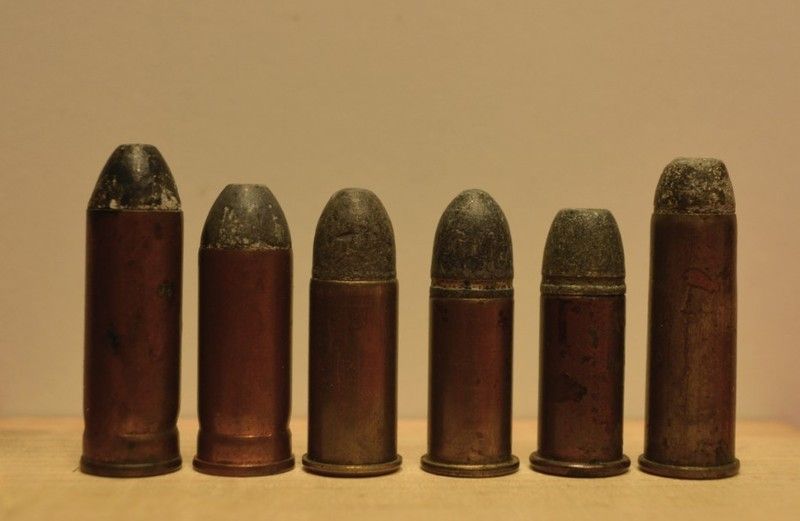
The 44 Henry was a copper cased rimfire round. It held about 26 grains of Black Powder under a 200 grain bullet. Not a power house, but about all the old brass framed (actually bronze) toggle link rifle could stand. the Henry's successor, the 1866 Winchester had the same relatively weak toggle link action and brass frame, so it too was chambered for the Henry round. When the Model 1873 Winchester came out, it had an iron frame to be able to handle the more powerful 44-40 round, which held about 40 grains of powder under a 200 - 230 grain bullet.
Some of the very early 1860 Henry reproductions that Navy Arms had built were actually chambered for the Henry round, but the ammunition had not been commercially available for years, so later models were chambered for 44-40 and 45 Colt.
My Uberti 1860 Henry is chambered for 44-40. I have a few old Winchesters chambered for 44-40 too.
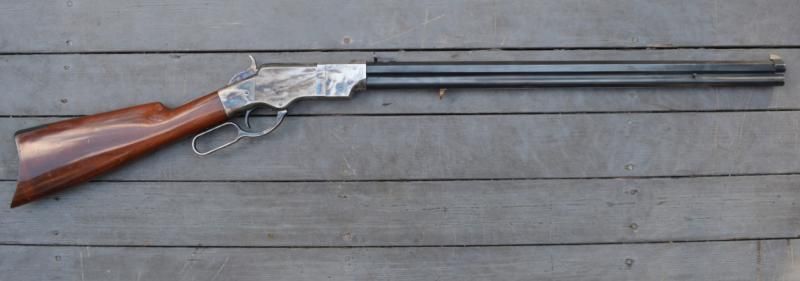
While the 1873 Winchester was stronger than the Henry and 1866, because of the iron frame, the toggle link action inside was still relatively weak, so 44-40 was about as powerful a round as you could chamber in it. The 1873 Winchester was also chambered for 38-40, 32-20, and 223 Short.
When the 1892 Winchester came along it had a much stronger action, but its most common chambering was still 44-40.
The real beauty of 44-40 is that it and 38-40 are the bee's knees for the Black Powder shooter. The brass at the case mouth of these rounds is much thinner than a 45 Colt, so the brass swells to seal the chamber better than the thicker brass of 45 Colt. With the chamber well sealed, almost all the fouling stays in the bore where it belongs. 45 Colt rifles, with their thicker brass are often plagued by blowby that lets fouling past the chamber and into the action.
Left to right in this photo, the original Benet primed version of the 45 Colt, Benet primed 45 Schofield, 44 Russian, 44 American, 44 Henry Rimfire, 44-40. Since these rounds are filled with Black Powder without any airspace, the length of each round is a pretty good indicator of their relative power.
The 44 Henry was a copper cased rimfire round. It held about 26 grains of Black Powder under a 200 grain bullet. Not a power house, but about all the old brass framed (actually bronze) toggle link rifle could stand. the Henry's successor, the 1866 Winchester had the same relatively weak toggle link action and brass frame, so it too was chambered for the Henry round. When the Model 1873 Winchester came out, it had an iron frame to be able to handle the more powerful 44-40 round, which held about 40 grains of powder under a 200 - 230 grain bullet.
Some of the very early 1860 Henry reproductions that Navy Arms had built were actually chambered for the Henry round, but the ammunition had not been commercially available for years, so later models were chambered for 44-40 and 45 Colt.
My Uberti 1860 Henry is chambered for 44-40. I have a few old Winchesters chambered for 44-40 too.
While the 1873 Winchester was stronger than the Henry and 1866, because of the iron frame, the toggle link action inside was still relatively weak, so 44-40 was about as powerful a round as you could chamber in it. The 1873 Winchester was also chambered for 38-40, 32-20, and 223 Short.
When the 1892 Winchester came along it had a much stronger action, but its most common chambering was still 44-40.
The real beauty of 44-40 is that it and 38-40 are the bee's knees for the Black Powder shooter. The brass at the case mouth of these rounds is much thinner than a 45 Colt, so the brass swells to seal the chamber better than the thicker brass of 45 Colt. With the chamber well sealed, almost all the fouling stays in the bore where it belongs. 45 Colt rifles, with their thicker brass are often plagued by blowby that lets fouling past the chamber and into the action.
Still, it chambers the 44-40, and that seems like a lesser round than such a rifle could use.
Is there anything special about this cartridge, other than quaint?
40 grains of black powder is nothing to sneeze at. Note how all the "top end" pistol (revolving pistol
 ) round of the black powder era topped out there.
.38-40, .44-40, and .45 Colt, all loaded with 40 grains of black powder.
More modern cartridges, including those designed in the smokeless powder era essentially don't surpass the power of the "40grain" rounds until you reach the .357Magnum, and then later the .44 Magnum.
The original lever guns were not particularly strong guns, adequate for the pressures of the day, but not well suited (even when made with modern steels) for much more. Later designs used different locking systems, better suited to higher pressures.
A Henry Original? The name Original should give you a good clue to the intent of the maker, reproducing (as closely as practical) a period piece firearm.
I believe there is a Henry rifle available in .44Magum, as well as other calibers. Just not the "original" model.
The toggle link action was plenty strong enough (especially considering the 18-21,000psi working pressure of original BP loads). Strong enough that it was used for 45-75, 45-60, 40-60 and 50-95 (in the Model 1876 Winchester "Centennial" rifle), and strong enough that current production of the 1873 includes 357 Magnum (operating at 35,000psi). Winchester even tried blowing up a Model 1876 by overloading and intentionally forcing a bullet into the bore in front of the loaded cartridge. They succeeded in blowing the side plates off of it but not getting it to fail, so they decided that they had better quit before someone got hurt. So that old "not very strong" argument raises a few other questions. But the 1866/73/76 were expensive to make, so when that John Browning guy offered the folks at Winchester an alternative (the Model 1886 and later Model 1892), they agreed, yet they kept making the 1873 for three decades after the 1892 hit the stores (because it wasn't as strong, you know).
Last edited:
Lever guns, save for a couple of designs, are not particularly strong, compared to something like a Mauser bolt action.
More than enough for black powder, and enough for more than that in later designs, but the early guns even aside from Iron and brass, are not in the same league as the later ones.
I make a distinction between "not particularly strong" and "not very strong", but I can see how what is clear in my mind could be less clear to someone reading it.
The Henry toggle link is not the same as a Savage 99 despite being plenty good for what it was made for, and maybe a bit more.
More than enough for black powder, and enough for more than that in later designs, but the early guns even aside from Iron and brass, are not in the same league as the later ones.
I make a distinction between "not particularly strong" and "not very strong", but I can see how what is clear in my mind could be less clear to someone reading it.
The Henry toggle link is not the same as a Savage 99 despite being plenty good for what it was made for, and maybe a bit more.
Is there anything special about this cartridge, other than quaint?
No, not really. It is adequate for the task, but it is just as easy to run 44 SPC through a 44 Mag lever rifle to get the same level of ballistic performance.
That being said, nostalgia is a powerful selling point. A lot of the animals being hunted out west had very little human hunting pressure higher (at least humans with firearms) so the 44-40 would serve very well. But take a look at how the standard lever rifle cartridge turned into the 30-30 relatively quickly once introduced.
Jimro
This is from last year. About a 45 yard shot. The rifle is a Uberti 24 inch barreled 1873 Winchester replica in .44-40. The load was a 200 grain lead bullet and a compressed 40 grains of 3fff goex black powder. The deer stopped quartering away from me. When I fired, the bullet struck a small sapling, passed through, struck the deer just in front of the right rear rib and exited through her left shoulder. She went about fifteen yards before piling up. Within 125 yards the .44-40 is a more than adequate round for deer size and smaller game. Not advising it, but I know in WV a lot of old timers used them to hunt black bears too.


I have a friend whom I was with at least 15 years ago, when he purchased from a local rancher an 1866 Winchester in .44-40 cal. It is a beautiful thing indeed; a full rifle with an octagon barrel (I would guess at least 24" long), and in very good to excellent vintage condition. He also paid right around 10k for it, too. I always thought that the '66 was only chambered in .44 rimfire, but the chambering was one of the big reasons my friend put out the $$ to buy it. From what I understand, the later model 66, with the high serial numbers did have that chambering, but are rather rare. (?) It's the only truly fine old Winchester I ever got to handle, fondle, shoulder and sight down barrel.
While it's true that Uberti's 1860, 1866, and 1873's action is strong enough to withstand an overcharge and a 357mag load. The truth is that over time the pins oval the holes in the toggles and the action gets loose increasing the headspace and ultimately allowing a case failure. Talk to Steve Young of Steve's Guns who is big in SASS about their long term tightness. As the owner of both a Uberti 1866 and 1873, I agree that they are beautiful rifles and great fun but realistically, their action design is best used with black powder level loads in the 14,000-18,000psi range for long term safety and reliability. Yes, the steel framed Uberti 1873 44mag is stronger than other 1873s, but it too is not up to a long term many thousand rd diet of high pressure loads. As both my Ubertis are 45 Colt, I keep their loads just below the 14,000psi level of the original black powder cartridge.The toggle link action was plenty strong enough (especially considering the 18-21,000psi working pressure of original BP loads). Strong enough that it was used for 45-75, 45-60, 40-60 and 50-95 (in the Model 1876 Winchester "Centennial" rifle), and strong enough that current production of the 1873 includes 357 Magnum (operating at 35,000psi). Winchester even tried blowing up a Model 1876 by overloading and intentionally forcing a bullet into the bore in front of the loaded cartridge. They succeeded in blowing the side plates off of it but not getting it to fail, so they decided that they had better quit before someone got hurt. So that old "not very strong" argument raises a few other questions. But the 1866/73/76 were expensive to make, so when that John Browning guy offered the folks at Winchester an alternative (the Model 1886 and later Model 1892), they agreed, yet they kept making the 1873 for three decades after the 1892 hit the stores (because it wasn't as strong, you know).
I also own 2 Rossis in 357mag and as the 1892 action is significantly stronger, I have no concern shooting Elmer Keith level 357mag loads in them. The action design is so strong Rossi chambers it in 454 Casull; a 60,000psi round. Consider the bolt thrust table I made up below for the 1873. It shows the thrust of the calibers it was designed for and the thrust of the modern ones it can fire. The max load the most powerful caliber, the 44-40 exerted was under 2,400lbs while the 38-40 actually produced a higher bolt thrust but still under 2,400lbs. The 28spl, 38spl+P, 44spl, and stand pressure 45 Colt produce bolt thrust levels equal to the calibers it was designed for. Now look at what full power 357mag, 45 Colt+P, 45 Colt Ruger level, and 44mag produce. You decide.

Driftwood Johnson
New member
I have a friend whom I was with at least 15 years ago, when he purchased from a local rancher an 1866 Winchester in .44-40 cal. It is a beautiful thing indeed; a full rifle with an octagon barrel (I would guess at least 24" long), and in very good to excellent vintage condition. He also paid right around 10k for it, too. I always thought that the '66 was only chambered in .44 rimfire, but the chambering was one of the big reasons my friend put out the $$ to buy it. From what I understand, the later model 66, with the high serial numbers did have that chambering, but are rather rare. (?) It's the only truly fine old Winchester I ever got to handle, fondle, shoulder and sight down barrel.
Howdy Again
I seriously doubt your friend's rifle was chambered for 44-40.
The Model 1866 was never factory chambered for 44-40. The cartridge was too long. Go back and study my photo of cartridges. Notice how much longer the 44-40 is than the 44 Henry Rimfire. The carrier of the Henry and '66 was too short to accommodate the much longer 44-40 cartridge. Towards the end of production, Winchester chambered the Model 1866 for a centerfire version of the 44 Henry Rimfire. Perhaps that is what your friend had. This cartridge had the same dimensions as the Henry round, with the exception that it was centerfire. According to George Madis in his Winchester Handbook, 1020 Model '66s were converted to centerfire and shipped to Brazil in 1891. Over the years, many Model 1866 Winchesters were converted to various centerfire cartridges, but not 44-40. The carrier was too short. I had a chance to examine a Model 1866 last year that was chambered for the centerfire cartridge. The carrier was short just like on any other '66.
The carrier of the Model 1873 was longer than the carrier of the Model 1866, for the longer cartridge, and the frame was slightly longer in the area of the carrier to house the longer carrier.
Because the 44 Rimfire ammo is not produced anymore, modern reproductions of the Henry and 1866 Winchester are produced with a longer carrier and the frame is slightly longer in the area of the carrier to accommodate longer cartridges such as 44-40 and 45 Colt. The Uberti part for the carrier of the 1866 is the same part used in their version of the '73. The Henry carrier is slightly different, because there is no cutout for the loading gate.
This is the view looking down on the carrier of my Uberti replical 1860 Henry, chambered for 44-40. Notice how the cartridge takes up just about the entire carrier. The much shorter carrier of the original Model 1866 simply was not long enough for this cartridge.

Thanks for correcting my caliber comment. It was a while back when my friend got the rifle, and I knew that it was a center-fire instead of a rim. I haven't followed the cartridge history of the old Winchesters, and I've never heard of the .44 center-fire, so I just took it that it was a .44-40. I'll have to quiz him on that when I ever see him again. He had a nice collection of vintage Winchester levers, all in very good to excellent condition, and the '66 he got when I was with him filled that Yellowboy slot. He had one each of the '73, '76, '86, '92 and the '94 but I don't believe he had the '95. He had a Uberti Henry to represent that rifle's place, as he said to find one of those in the condition he'd like to have was just too pricey. Thanks again, I've enjoyed this thread; always a learning experience here.
Now that's funny! I like the 44-40 too, but for Cowboy Action Shooting. I shoot that cartridge in Italian replicas of the 1873 Winchester, and the 1860 "Henry" produced by the New Haven Arms Co. (Not to be confused with the modern rifles produced by the Henry Repeating Arms Co.)Its good for nothing.
Except deer. And turkey. And rabbit. And squirrel. And fox. And badmen. And plinking.
Quaint cartridge, the 44-40.
http://www.cdnnsports.com/winchester-1873-44-40-short-rifle.html#.VnwCpXarRj0
1 unit left!
Must...resist...temptation...
1 unit left!
Must...resist...temptation...
Joe 45 and all,
Haven't seen my old friend in some time; we used to have a group we'd rendezvous with for many years in the old buckskinning days, and of course, other than muzzleloaders, the "any" gun talk was always high in conversation. I hope he still has those rifles, and maybe at some point down the trail I'll run into him again and quiz him some on the Winchesters. Anyway, he had the means at the time to find the lever guns he wanted for his collection. He had some really nice old Colts, too, and a very fine full-stock flint rifle built by Don King in .54 cal.
Both of my boys have pre-64, M94 Winchesters. My oldest son has a, yup, .32 Winchester Special (made in the mid '50's), which I hunted with for many years, and was my only rifle back in the 70's. It's still a fine old accurate rifle, and back then I didn't hand-load, so the only shelf ammo that was available to buy were the 170 grainers, and the Silvertips if I could find them. The .32 ammo was always available back then, but it's just seasonal stuff now. Actually, when I think back on the .32 ammo deal, it was just alright that when you went to buy a box of shells, there was no thinking as to bullet weight, it was just what brand you wanted, if you had a choice, but they were always 170 grainers. I should get some dies and run a bunch for my kid. Luckily, I picked up the brass through the later years when I used it, and still have it in the original boxes, mostly Federal.
My youngest son has mid-50's M94 in 30-30 and he killed his first deer with that one back in the later 90's; a nice mulie doe with one shot at near 100 yds. (150 grain Speer flat points that I loaded for him, along with 31 grains of IMR 3031; good load BTW). I wish I had his eyes... It's an accurate little carbine, too. Can't beat a '94 for handy and accurate.
I don't do the cowboy shooting, but I know some guys who do and have the discussions from time to time on the current guns of the game and the ammo. My cowboy rig (I like to call it that; gotta have one living in Wyoming) is a Marlin 94S in .41 Remington Mag. (my only lever these days), and a New Model Blackhawk in the same caliber. I've had the Ruger for over 30 years, and tricked it out with a Super Blackhawk hammer (very slick). I hand-load the Speer Gold Dot 210 grainers with 20 grains of H110 to use in both guns. I like that combo a lot. I found the 94S some years ago on GB, and was very lucky to get it for a good price, in the box, and near pristine condition; a great little carbine, certain sure.
Merry Christmas to all, and to a New Year of fun, safe shooting!
reinert
Haven't seen my old friend in some time; we used to have a group we'd rendezvous with for many years in the old buckskinning days, and of course, other than muzzleloaders, the "any" gun talk was always high in conversation. I hope he still has those rifles, and maybe at some point down the trail I'll run into him again and quiz him some on the Winchesters. Anyway, he had the means at the time to find the lever guns he wanted for his collection. He had some really nice old Colts, too, and a very fine full-stock flint rifle built by Don King in .54 cal.
Both of my boys have pre-64, M94 Winchesters. My oldest son has a, yup, .32 Winchester Special (made in the mid '50's), which I hunted with for many years, and was my only rifle back in the 70's. It's still a fine old accurate rifle, and back then I didn't hand-load, so the only shelf ammo that was available to buy were the 170 grainers, and the Silvertips if I could find them. The .32 ammo was always available back then, but it's just seasonal stuff now. Actually, when I think back on the .32 ammo deal, it was just alright that when you went to buy a box of shells, there was no thinking as to bullet weight, it was just what brand you wanted, if you had a choice, but they were always 170 grainers. I should get some dies and run a bunch for my kid. Luckily, I picked up the brass through the later years when I used it, and still have it in the original boxes, mostly Federal.
My youngest son has mid-50's M94 in 30-30 and he killed his first deer with that one back in the later 90's; a nice mulie doe with one shot at near 100 yds. (150 grain Speer flat points that I loaded for him, along with 31 grains of IMR 3031; good load BTW). I wish I had his eyes... It's an accurate little carbine, too. Can't beat a '94 for handy and accurate.
I don't do the cowboy shooting, but I know some guys who do and have the discussions from time to time on the current guns of the game and the ammo. My cowboy rig (I like to call it that; gotta have one living in Wyoming) is a Marlin 94S in .41 Remington Mag. (my only lever these days), and a New Model Blackhawk in the same caliber. I've had the Ruger for over 30 years, and tricked it out with a Super Blackhawk hammer (very slick). I hand-load the Speer Gold Dot 210 grainers with 20 grains of H110 to use in both guns. I like that combo a lot. I found the 94S some years ago on GB, and was very lucky to get it for a good price, in the box, and near pristine condition; a great little carbine, certain sure.
Merry Christmas to all, and to a New Year of fun, safe shooting!
reinert