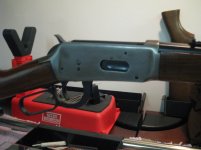
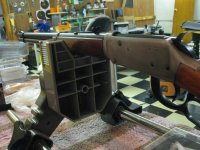
Please check out my attached pic of my Winchester Model 94. This rifle was as per serial number was made in 1964. I've had this rifle for a while, acquired it in a trade and am wonder if anyone has seen this receiver finish before. The barrel is blued and gorgeous as well as everything else that is supposed to be. Except for this receiver, the way the finish is, inside the receiver and out, it appears to be factory. Can my assumptions be correct? Or did someone just do a really good job of removing the bluing some time ago?

You are using an out of date browser. It may not display this or other websites correctly.
You should upgrade or use an alternative browser.
You should upgrade or use an alternative browser.
1964 Winchester Model 94 Receiver Finish?
- Thread starter SRE
- Start date
In 1964 Winchester changed several things about the Model 94 to cheapen manufacture, which also cheapened quality.
One was the switch to a sintered metal (sorta a cast process) in place of a forged steel frame.
The new process metal wouldn't take conventional bluing, so it was iron plated, and the iron could then be blued.
The result was a finish that didn't hold up well with use & frequently ended up wearing off or rusting. Or both.
Denis
One was the switch to a sintered metal (sorta a cast process) in place of a forged steel frame.
The new process metal wouldn't take conventional bluing, so it was iron plated, and the iron could then be blued.
The result was a finish that didn't hold up well with use & frequently ended up wearing off or rusting. Or both.
Denis
As mentioned above, they tried to make them cheaper by changing the
receiver metal. The finish wears, gets rust freckles, and generally doesn't
hold up well.
I sort of suspect that your gun has been refinished. The edges on the
receiver look a little soft, and some of the screw holes look a touch
dished. One of the other attributes of the "new and improved" '64
metal was that it doesn't re-blue well. Usually comes out some shade of
gray or purple. Your finish is pretty even over the whole receiver, I'm
thinking it was polished out and tanked, with poor results.
receiver metal. The finish wears, gets rust freckles, and generally doesn't
hold up well.
I sort of suspect that your gun has been refinished. The edges on the
receiver look a little soft, and some of the screw holes look a touch
dished. One of the other attributes of the "new and improved" '64
metal was that it doesn't re-blue well. Usually comes out some shade of
gray or purple. Your finish is pretty even over the whole receiver, I'm
thinking it was polished out and tanked, with poor results.
Polished out and tanked?
I know all about pre/post 64 pre/post war etc... this receiver just looks different, and its hard to explain. Pics do not do it justice, in person the gun looks almost like you want to say it came that way from the factory. But pointed taken on the dishing. I can see that faintly.
I know all about pre/post 64 pre/post war etc... this receiver just looks different, and its hard to explain. Pics do not do it justice, in person the gun looks almost like you want to say it came that way from the factory. But pointed taken on the dishing. I can see that faintly.
I had one that went motley off colored. I tried to cold blue it but it didnt take well. After trying several types, the stuff from Brownells did best, tho it looked more like color case hardening than blue. A guy on the leverguns forum refinished one by carefully sanding/polishing off the iron plating, then cold blueing, it turned out pretty decent actually. It took the cold blue pretty well.
My ex-son in law has a post 64 M94 that had the bluing on the receiver go bad. He polished the reeiver down to bare metal and cave it some kind of clear coating that was not shiny. Make a pretty nice looking gun. I do have an M94 made on or about 1981 (when I bought it NIB) that is a servicable rifle but is a bit loose and rattely. Shoots OK and is good enough to be a truck gun. Shoots cast bullets just fine. If the receiver ever gets ratty looking, so be it. After all, truck guns ain't supposed to look purty. 
Paul B.
Paul B.
Jack O'Conner
New member
The alloy used in the mid-1960's to late 1970's did not "hold" traditional bluing very well. One way to refinish is with powder-coating in flat black.
Jack
Jack
The alloy used in the mid-1960's to late 1970's did not "hold" traditional bluing very well. One way to refinish is with powder-coating in flat black.
I'd rather have it scruffy looking.
Mike Irwin
Staff
I thought Winchester went to a cast receiver in 1964, not a sintered metal receiver...
Mike Irwin
Staff
I've looked into it a bit more and yep, it's sintered graphitic steel.
Interesting. I had thought that they went to castings.
Interesting. I had thought that they went to castings.
@MIKEIRWIN: Like you, I always thought it was a casting. Powdered metal technology was still in its infancy in 1964, and I've been skeptical that a receiver could be made with the necessary tensile and shear strength for that application. However, I'm not a metallurgist.
I've never found an authoritative source for the casting versus sintered metal question in the post '64 receivers. Apparently you did. Thanks for setting the matter to rest.
I've never found an authoritative source for the casting versus sintered metal question in the post '64 receivers. Apparently you did. Thanks for setting the matter to rest.
Mike Irwin
Staff
Hammie,
Let's make certain that we're talking correct terms...
The receivers are NOT metal injection molded, in which powdered metal is put into a form and then subjected to extreme pressure.
In the sintering process apparently used by Winchester, powdered metal is put into a form, which is then heated to melt the metal. At least I think that's the process that Winchester used.
That kind of sintering process allows very precise control of additives to the metal powder, giving the finished product the exact properties that they want.
Apparently the process is faster, and cheaper, than the traditional method of milling from a billet of steel.
It's SORT of like casting in that both use forms.
Let's make certain that we're talking correct terms...
The receivers are NOT metal injection molded, in which powdered metal is put into a form and then subjected to extreme pressure.
In the sintering process apparently used by Winchester, powdered metal is put into a form, which is then heated to melt the metal. At least I think that's the process that Winchester used.
That kind of sintering process allows very precise control of additives to the metal powder, giving the finished product the exact properties that they want.
Apparently the process is faster, and cheaper, than the traditional method of milling from a billet of steel.
It's SORT of like casting in that both use forms.