Well, I've had a chance to shoot a bit with two 223 ruger 77s. One is an older stainless 1:12 twist and the newer is a hawkey with 1:9. The hawkeye shoots fantastic with 65 grain sierras, so so with 68 hornady's and ok with 60 grain pills. 55 grain accuracy is ok with vmax but completely sucks with military ball. Forget trying to group a 45 or 50 grain bullet in the 1:9. So far with 1:12 twist 55 grain military ball has done fairly well. Looking forward to shooting a wider range of bullets in the 1:12. I suspect it's going to do very well with 50 to 60 grain bullets but will probably keyhole the 65 grain pills which require 1:10 or tighter twist. Seems like the 1:12 is a bit better choice for the lighter frangible bullets up to 60 grains but 1:9 is better for the 60 to 65 grain bullets but still marginal for the 68 to 77 grain bullets. How light can bullets be and still shoot accurately in 1:12 twist guns? How light a bullet have you been able to use in a 1:9 and still retain a high degree of accuracy?

You are using an out of date browser. It may not display this or other websites correctly.
You should upgrade or use an alternative browser.
You should upgrade or use an alternative browser.
1:12 VS 1:9 in Sporter Rifle 223
- Thread starter rc
- Start date
When given a choice, always go with the faster twist.
Heavy twist will shoot lighter bullets but the slower twist wont shoot heavy bullets.
This is out of the Army manual dealing with 1:7 vs. 1:12, it's the same with the 1:9 but you wont have success with the 77-90 gr bullets. but < 69 gr should work in the 1:9.
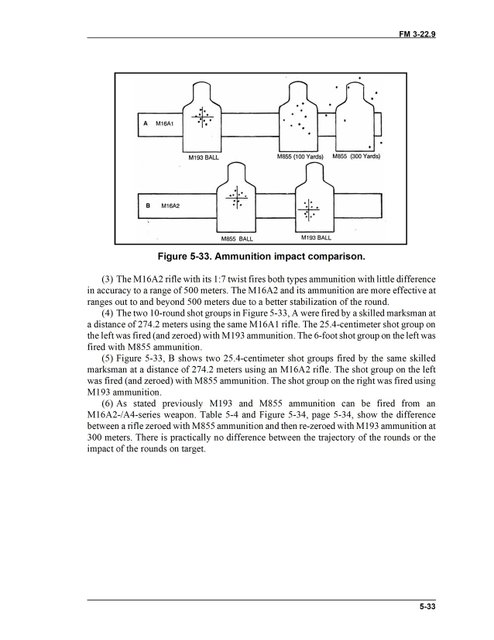
Heavy twist will shoot lighter bullets but the slower twist wont shoot heavy bullets.
This is out of the Army manual dealing with 1:7 vs. 1:12, it's the same with the 1:9 but you wont have success with the 77-90 gr bullets. but < 69 gr should work in the 1:9.
It depends on economy for me, I am, after all, a cheap SOB. I generally use either Hornady FMJ's or Privi. For varmints I use 40-50-55 grain V-Max or Ballistic tip bullets.
Of course for the sake of economy I know the turret settings for each load, and I can also go to those settings from mechanical zero if I get confused (Which seems to happen more often as I get older). All my come ups and windage settings are from mechanical zero, which is why a record book is so important.
When you step into bullets above 60 grains they tend to get more expensive. Why? To punch paper? To kill varmints? I can see that if you are shooting match but IMHO it is a waste for anything else. Then again, like I said, I am a cheap SOB. So I'd figure exactly what the rifle is for and buy the twist that shoots the most suitable bullet the best. If you really want to reach out buy a 22-250
Of course for the sake of economy I know the turret settings for each load, and I can also go to those settings from mechanical zero if I get confused (Which seems to happen more often as I get older). All my come ups and windage settings are from mechanical zero, which is why a record book is so important.
When you step into bullets above 60 grains they tend to get more expensive. Why? To punch paper? To kill varmints? I can see that if you are shooting match but IMHO it is a waste for anything else. Then again, like I said, I am a cheap SOB. So I'd figure exactly what the rifle is for and buy the twist that shoots the most suitable bullet the best. If you really want to reach out buy a 22-250
One reason why heavy bullets cost more than light ones is they've got more material in them. You've got to pay more for 80 grains of lead and copper compared to only 40 grains. Bullet making companies do that and they pass that added expense on to the customers to cover. It's the only way they can stay in business.
One reason why heavy bullets cost more than light ones is they've got more material in them. You've got to pay more for 80 grains of lead and copper compared to only 40 grains. Bullet making companies do that and they pass that added expense on to the customers to cover. It's the only way they can stay in business.
that is true of course, but only partially so. Many of the heavies are match bullets and QC is a bit higher. But the question is, what do you really need for what you are doing. If the objective is killing varmints you have one set of requirements, shooting score on a target, or just wanting to see the best accuracy is another. Blasting cans yet another. The actual intended purpose of the rifle has to be figured. If I'm shooting match then I have one set of requirements and but the bullets to match that requirement, shooting woodchucks out to several hundred yards is a different matter.
get the 1:9 to be able to fire heavier bullets. I think it's a myth that slower twists shoot lighter bullets better/more accurately. If it's not fast enough to spin the bullet apart, then the bullet is just spinning faster and gaining stability. I see no advantage getting the 1:12.
You have to look at the spin factor of the bullet. Most rifles are designed to fire a bullet of a specific weight at a rotational spin factor of 1.5. That leaves a wide margin for bullets and velocities.
The spin magnifies the effect of any imperfection in the bullet. So, the OP says he is shooting some Mil Ball ammo. Well, mill ball ammo is full of imperfections. They don't matter for their intended purpose which is to be fired in combat from a full auto, they are not made to be paper punchers.
Standard hunting bullets tend to have a certain level of imperfections. Match bullets much less so. Military bullets are the worst in that regard.
The spin magnifies the effect of any imperfection in the bullet. So, the OP says he is shooting some Mil Ball ammo. Well, mill ball ammo is full of imperfections. They don't matter for their intended purpose which is to be fired in combat from a full auto, they are not made to be paper punchers.
Standard hunting bullets tend to have a certain level of imperfections. Match bullets much less so. Military bullets are the worst in that regard.
Sweet Shooter
New member
Keyholing
I think it's over exaggerated hype. I have never seen a bullet of any weight keyhole out of my 1x12 rifles, inside of 200 yards. But then I can't see further than that anyway. Not saying it doesn't happen. I postulate that the depth/quality/crispness/definition of the lands and grooves is more important... for my requirements than the twist rate.
Most rifles with 1x7, 1x8, 1x9 that I have had, have displayed only so-so accuracy.
My most accurate rifle is a 1x12 with any (sensible) weight bullet. My favorite is 50 grain out of the 1x12, because it's flat. But for practical purposes the 62 grain performs admirably out of the same barrel out to 200 yards.
-SS-
I think it's over exaggerated hype. I have never seen a bullet of any weight keyhole out of my 1x12 rifles, inside of 200 yards. But then I can't see further than that anyway. Not saying it doesn't happen. I postulate that the depth/quality/crispness/definition of the lands and grooves is more important... for my requirements than the twist rate.
Most rifles with 1x7, 1x8, 1x9 that I have had, have displayed only so-so accuracy.
My most accurate rifle is a 1x12 with any (sensible) weight bullet. My favorite is 50 grain out of the 1x12, because it's flat. But for practical purposes the 62 grain performs admirably out of the same barrel out to 200 yards.
-SS-
603Country
New member
In response to RC,s last question, my Hawkeye shoots the 40 gr Nosler BT very well. And like yours, it shoots the Sierra 65 gr GK extremely well. For sure I would get the 1 in 9 twist.
Sweet Shooter, thanks for offering your practical experience. I think with most trigger yankers can't tell the difference from AR platform rifles at any distance because they are happy to hit a man sized target reliably center mass. Heck I can do that with my rifle, but I'm more interested in varmint hunting accuracy. I'm trying to land bullet on top of bullet into tiny <1" groups at 100 yards +. I can only do that in the 1:9 with the 65 grain sierra's consistently. I'm lucky to get a 1 to 1.5 inch group with the Hornady 68 out of the same 1:9 twist rifle at the same distance. Still great combat accuracy but certainly not bench rest winning accuracy. Guys seem to get little tiny cloverleafs with the 1:12 twist and 50 or 52 grain match type bullets which is better for bench rest competition and varmint hunting. Most available 223 ammo is 55 grain ball. That means the most commonly available ammo in 223 shoots better in 1:12 than 1:9. Now as has been stated, maybe the difference with ball ammo is minimal. However, with better quality bullets, the difference seems to be significant.
Sweet Shooter
New member
RC... I agree. However the ball/MC/FMJ ammo rarely shoots as well as the premium stuff because it is flying backwards.
Most bullets are "Cup and Core". Open-tip/HP/PSP/B-tips fly "open forward". Ball flies open backwards... it has an open base. It's that irregular shaped open base at any weight, from any twist rate that will not stabilize well. In my experience.
My 1x12 will hold 1.5 MOA at 200 yards. Much past that I can not tell a p-dog from a Dachshund. But inside 200 yards and preferably 150 not much can live on the difference between 50 grain and 69 grain from my 1x12. Put an FMJ into the mix and more that 80 percent of those p-dogs are looking good to live another day.
-SS-
Edit... sorry I meant "My 1x12 will hold 1.5 'inches' at 200 yards."
Most bullets are "Cup and Core". Open-tip/HP/PSP/B-tips fly "open forward". Ball flies open backwards... it has an open base. It's that irregular shaped open base at any weight, from any twist rate that will not stabilize well. In my experience.
My 1x12 will hold 1.5 MOA at 200 yards. Much past that I can not tell a p-dog from a Dachshund. But inside 200 yards and preferably 150 not much can live on the difference between 50 grain and 69 grain from my 1x12. Put an FMJ into the mix and more that 80 percent of those p-dogs are looking good to live another day.
-SS-
Edit... sorry I meant "My 1x12 will hold 1.5 'inches' at 200 yards."
Last edited:
My most accurate rifle is a 1x12 with any (sensible) weight bullet
Um, that's assuming you aren't shooting medium to long range. Trust me, 52-55 gr match bullets suck at 600 and 1000 yards, I know, I've tried them
And I'm not buying the 1:7 twist aren't accurate. The army uses 1:7 in their Mann devices to test ammo.
You don't think the faster twist aren't accurate, find someone with a White Oak and try it out.
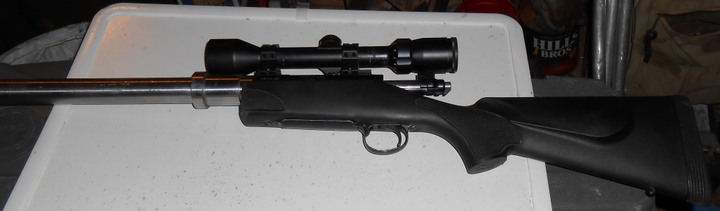
Or come over and try this puppy for accuracy, its 1:7.
Mann Accuracy Device, Remington 700 action, Kart 1:7 5.56 barrel.
Sweet Shooter
New member
kraigwy, I do get that. I wouldn't say that 1 x 7 can't be accurate—I never said that. I said that the the rifles I have had with those kind of twist rates did not impress me. I've never shot one with VLDs to 500 yards or beyond, and personally have no interest generally in what's beyond 200 yards... but that's just me. I think there are better cartridges for that kind of range if one is interested in "real" accuracy. I can ring a gong at 600 yards here at a local range but, I don't demand MOA from the cartridge at that distance. If a rifle can hold MOA to 200 yards with say... 55 grain I'm happy.
I do appreciate and value that there are folk who do push the .223 out to extremes. I think I'd go broke trying. ha ha.
One more thing, I like the 1x12 purely for it's speed. They have always shot faster and flatter than the tight twist with a given (factory) load for me.
-SS-
I do appreciate and value that there are folk who do push the .223 out to extremes. I think I'd go broke trying. ha ha.
One more thing, I like the 1x12 purely for it's speed. They have always shot faster and flatter than the tight twist with a given (factory) load for me.
-SS-
223 shooter
New member
How light a bullet have you been able to use in a 1:9 and still retain a high degree of accuracy?
I have .223 rifles with 1 in 12" twist ( Rem. Model 700VLS and 700SPS) and 1 in 9" twist (Rem. 700LTR and Savage 12BVSS) and have used the 52 Sierra match with the 1 in 9" twist barrels with accuracy results virtually identical to the 1 in 12 barrels. The below shot with a 20" LTR with 1 in 9". The rifle also performs well with the 69 Sierra.

I use match bullet loads and all my 223 rifles are heavy varmint barrels. Even my 1 in 8" twist Rock River Varmint AR shoots the 52 Sierra quite well.